
US and Canada seek to ease tensions
Canadian Prime Minister Mark Carney has held frank discussions with US President Donald Trump regarding outstanding issues in their bilateral trade relationship. This move signals an easing of tensions over tariffs between the two North American neighbours.
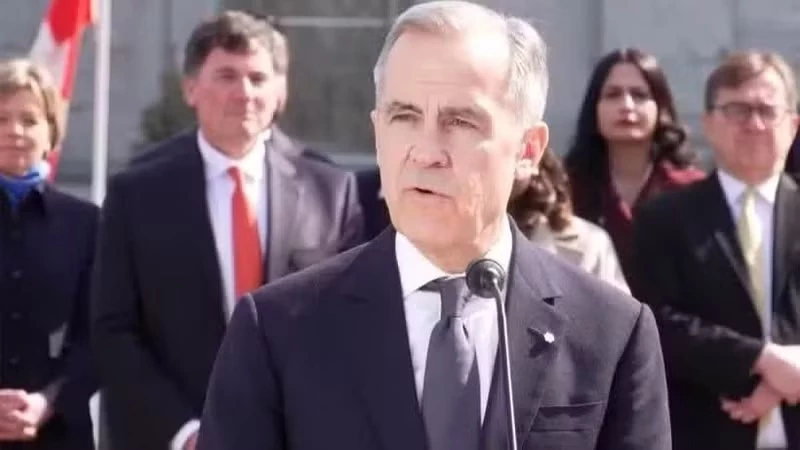 |
| Canadian Prime Minister Mark Carney. (Photo: Xinhua/VNA) |
Prime Minister Mark Carney stated that the two countries remain in regular contact, affirming that Ottawa stands ready to reach a balanced agreement that yields mutual benefits for both Canada and the US.
Amid strained trade relations between the two North American neighbours, the Canadian leader indicated that while he has no intention of escalating the dispute, he cannot compromise the country’s economic interests.
Conversely, the US has also signalled a willingness to compromise in an effort to de-escalate trade tensions with Canada.
In its latest package of trade measures regarding Ottawa, Washington has dropped some of the harshest retaliatory steps, postponed the implementation of certain levies, and withdrawn politically sensitive tariffs.
President Donald Trump had previously announced plans to raise tariffs on Canadian auto imports from 25% to 50% - a move analysts viewed as the most severe trade blow dealt to Ottawa.
However, the US has made a surprise move by pushing back the implementation date for these tariffs to early 2027. The White House also rescinded the 50% tariff announced two weeks ago on key Canadian goods such as salt, cement, and toilet paper.
Additionally, a three-week grace period has been established before import bans take effect, providing Washington and Ottawa with the time and opportunity to return to the negotiating table.
A senior US administration official revealed that the two sides have held constructive discussions and that negotiations will continue in the coming days. Trade tensions between the US and Canada flared up in July 2026 when President Trump threatened to impose a 50% tariff on certain Canadian goods, forcing officials from both nations to urgently return to the negotiating table.
Despite coming close to a framework agreement on tariff reductions for metals and automobiles, the negotiations ultimately collapsed, to the disappointment of citizens in both countries.
Consequently, the 50% tariff on billions of dollars’ worth of Canadian goods officially took effect in late August. Washington cited Ottawa’s alleged discrimination against US goods and commercial interests as the reason.
Going a step further, President Trump directed the General Services Administration (GSA), in coordination with the Office of the US Trade Representative (USTR), to remove Canadian-origin products from the federal government’s procurement list.
This move would make it difficult for Canadian businesses to access US government procurement contracts. In response, Ottawa imposed tariffs on hundreds of US products starting September 8.
Specifically, Canada levied retaliatory tariffs ranging from 15% to 50% on approximately 27.6 billion USD worth of US goods.
Prime Minister Carney acknowledged that the Canadian economy would suffer significant losses due to the trade tensions with the US, yet he remained steadfast in opposing agreements that would be detrimental to the economy in the long run.
Accordingly, Prime Minister Carney urged citizens to prioritise domestic goods and domestic travel as a means to weather the trade crisis with the US.
Bilateral trade between the US and Canada reached 880 billion USD in 2025. Without a breakthrough in negotiations, the bilateral trade relationship risks a rapid and severe decline. Observers express the hope that both sides will listen to each other and engage in frank dialogue with an open-minded attitude, aiming to de-escalate trade tensions for the benefit of their respective peoples and for the sake of regional and global stability.
NDO


READER COMMENTS