
A test for the Schengen Agreement
The Schengen Agreement, a symbol of solidarity, integration and the dream of a “borderless Europe”, is facing great pressure from migration flows.
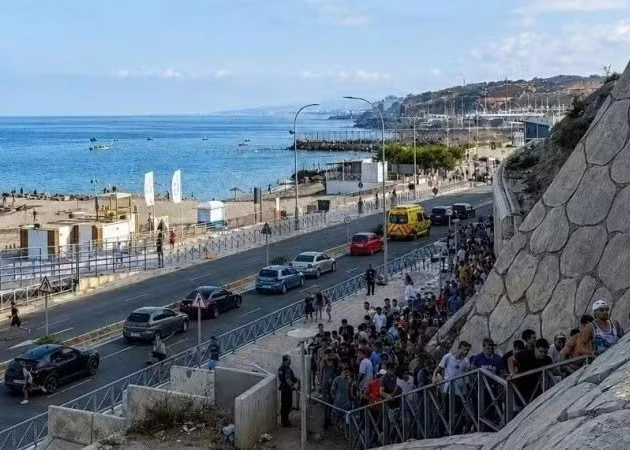 |
| Migrants illegally cross the border into Ceuta, a Spanish territory in North Africa, on July 30, 2026. (Photo: Xinhua) |
The restoration of internal border controls by some countries could weaken confidence in the principle of free movement and also raises questions about the European Union’s (EU) capacity for policy coordination in the face of external challenges.
Chaotic scenes in the Spanish city of Ceuta, where large numbers of migrants sought to cross the border illegally as a gateway to Europe’s “promised land”, made Ceuta a prominent name on the EU agenda throughout the first half of August.
Italy had to announce the suspension of the full application of the Schengen Agreement on free movement with Spain due to security concerns. France also immediately tightened security on its border with Spain, increasing the deployment of police and gendarmerie forces.
The migration crisis forced Ireland, which currently holds the rotating presidency of the Council of the EU, to activate a series of response mechanisms within just a few days. Moroccan security forces are still working to prevent hundreds of migrants from attempting to cross the border illegally into Ceuta.
European leaders have affirmed that the Schengen free movement area has not been affected by the incident in Ceuta, but this appears insufficient to dispel doubts about the vitality, sustainability and effectiveness of the Schengen Agreement.
In the past, the agreement was criticised as the “Achilles’ heel” of the Old Continent because of serious security loopholes. When the migration crisis broke out in Europe in 2015-2016, jihadist gunmen returning from the Middle East to Europe took advantage of free movement within the bloc to carry out terrorist attacks, putting regional security on high alert. Later, the outbreak of the Covid-19 pandemic forced countries to establish national border controls to prevent the virus from spreading.
Temporary border closures by governments in response to security challenges are understandable. However, this will affect the Schengen Agreement if temporary measures are used too frequently. Therefore, countries are now stepping up efforts to reform the agreement in a stricter and more effective direction, including renewing the system of external border entry and exit controls and applying technology to improve management efficiency and ensure security.
European solidarity and integration are being tested just two months after the EU completed its new legal framework on migration. The EU Pact on Migration and Asylum, seen as Brussels’ most comprehensive overhaul of migration management in years, officially came into force in June 2026.
The recent crisis in Ceuta shows that the issue is not only whether the EU has a migration control mechanism, but also how that mechanism operates in practice when a crisis occurs.
In addition, handling migration is not only about tightening control of external borders, but also about governance and intelligence-sharing. The EU is working closely with major social media platforms to prevent false information from inciting illegal border crossings, after misinformation was considered one of the causes of the mass influx of migrants into Ceuta.
The recent situation at the migration hotspot of Ceuta is not simply a story of opening or closing internal borders between countries. It is a test for the Schengen Agreement, raising questions about solidarity and the willingness to share responsibility when the security interests of individual countries collide with the core values of the bloc as a whole.
If every emerging crisis pushes countries back towards “closing their doors and drawing the bolts”, the value of the Schengen Agreement will be shaken to some extent. Public opinion is also waiting to see whether the EU Pact on Migration and Asylum is strong enough to prevent a repeat of the Ceuta scenario, amid a geopolitical situation that remains complex and unpredictable.
NDO


READER COMMENTS