
Human resources: The key to unlocking new development opportunities
Improving training quality, renewing educational approaches and strengthening links between educational institutions, businesses and the labour market are urgent requirements for training institutions in Tuyen Quang Province. During visits and working sessions at Tan Trao University and Tuyen Quang College, Provincial Party Secretary Hau A Lenh emphasised key orientations for making education and training a driving force in developing a skilled workforce to meet the province's needs in the new period.
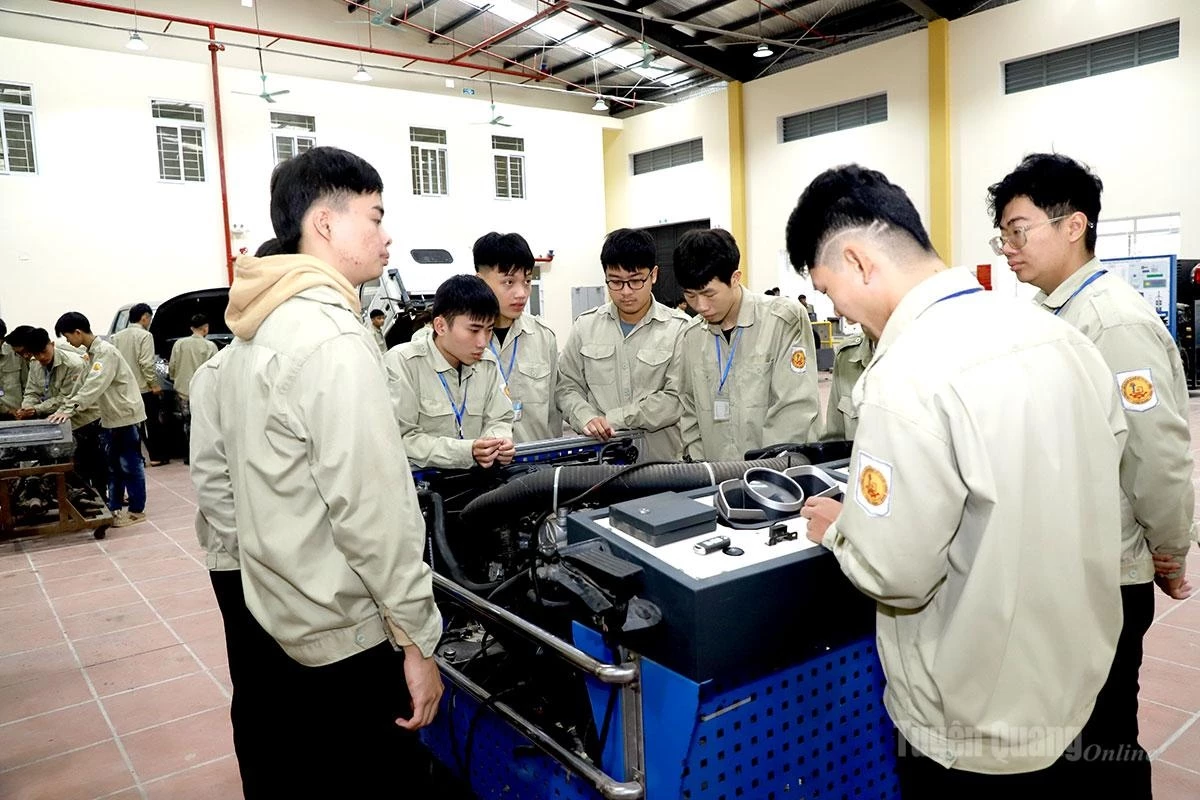 |
| A practical lesson for students at Tuyen Quang College. |
The Provincial Party Secretary stressed that training must shift from relying on existing institutional capacity to meeting the actual needs of society and local development priorities. Training institutions were urged to comprehensively review their operations, identify their strengths and shortcomings, and restructure training programmes in line with the province's demand for human resources.
For Tan Trao University, priorities include reviewing its training disciplines, improving programme quality, strengthening scientific research and applying knowledge to practical needs, particularly in education, healthcare, agriculture, tourism, economic management, science and technology, and digital transformation.
Meanwhile, Tuyen Quang College needs to focus on providing skilled technical workers for businesses, production facilities and key economic sectors. Decisions on training disciplines, enrolment and training scale should be based on recruitment demand and employment opportunities after graduation, avoiding mismatches between training and labour market needs.
Another key requirement is to make graduate outcomes the primary measure of training effectiveness. Businesses should be more actively involved in developing curricula, providing practical training and internships, assessing students' competencies and recruiting graduates. Workforce demand forecasting should also be strengthened to ensure training programmes align with the province's socio-economic development orientations and changing labour market trends.
The Provincial Party Secretary also called for improved operational efficiency following organisational restructuring at both institutions. The restructuring process should focus on consolidating resources, making effective use of facilities and teaching staff, and improving governance rather than merely changing organisational structures.
Relevant provincial agencies were asked to coordinate with the institutions to address difficulties related to mechanisms, policies, staffing, infrastructure and equipment, while supporting the development of specific plans and roadmaps.
In addition, the province needs to expand access to vocational training and professional development, particularly for rural workers, ethnic minority communities and residents in disadvantaged areas. This will help improve local workforce quality, create sustainable livelihoods, increase incomes and provide more opportunities for people to participate in economic activities.
These orientations highlight the importance of developing a workforce that meets practical demands, contributing to improved growth quality and laying a solid foundation for Tuyen Quang's rapid and sustainable development.
Ngoc Hung


READER COMMENTS