
Porcupine farming opens up new income opportunities
From just a few breeding porcupines, several households in Residential Group 20, An Tuong Ward have, after years of persistent efforts to build up their herds, developed a farming model that provides a stable income. Building on the model's practical results, households sharing an interest in porcupine farming have joined together to form a professional porcupine farming group, where they share experience, support each other with breeding stock and gradually expand their operations.
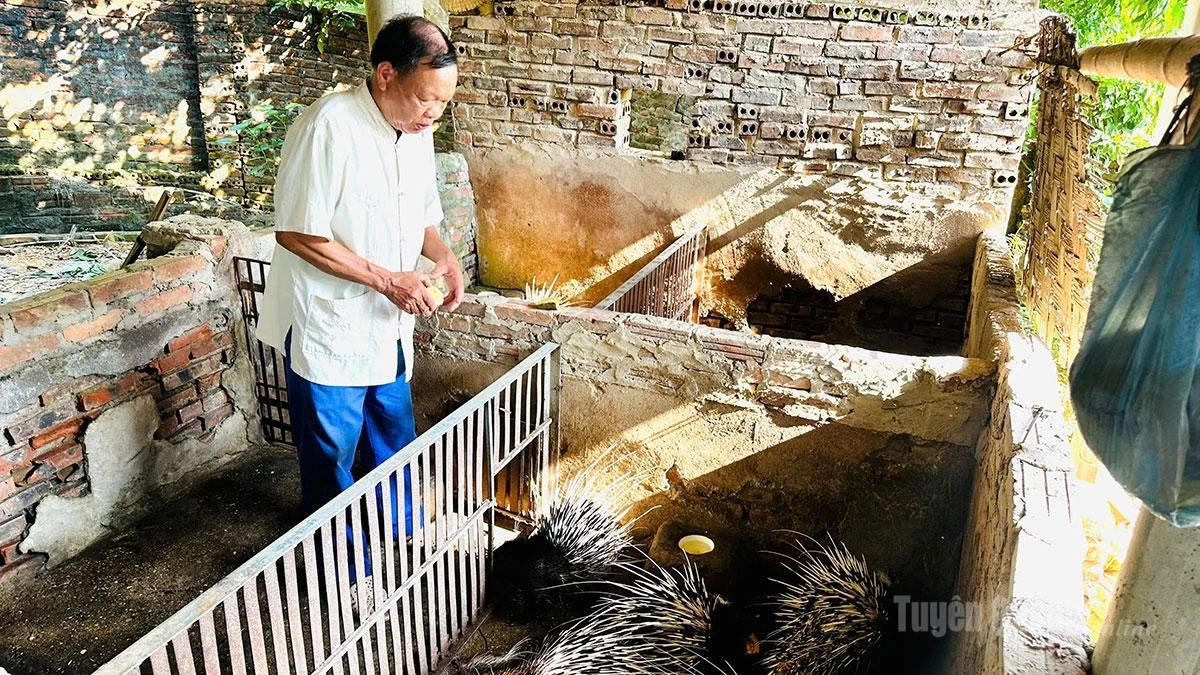 |
| Phan Van Chien, a resident of Residential Group 20, An Tuong Ward, earns a stable income for his family from porcupine farming. |
At the porcupine-raising facility of Phan Van Chien's family in Residential Group 20, An Tuong Ward, the pens are neatly arranged. His herd currently numbers more than 50 porcupines of different ages.
Few would have imagined that today's herd began with a bold decision made by Chien 17 years ago. In 2009, when most local families were still accustomed to raising buffaloes, cattle, pigs and chickens, Chien began researching porcupine farming. At the time, breeding porcupines were scarce, costing about VND5 million each, or VND10 million per pair. Meanwhile, his family's cattle were of low value and difficult to sell. After careful consideration, he decided to sell all six of his adult and young cattle. The proceeds were enough to buy only five breeding porcupines.
While raising them, Chien studied their growth characteristics, breeding methods and care techniques. More than a year later, the porcupines began reproducing. At a time when demand for breeding stock was high, his family was able to sell a pair of breeding porcupines for as much as VND14 million.
Breeding porcupines currently sell for around VND3 million per pair, while meat porcupines fetch VND280,000-300,000 per kilogram. With a herd of more than 50 porcupines of different ages, Chien's family earns around VND100-150 million a year from selling breeding stock and meat porcupines.
The success of Chien's model has gradually attracted other local households interested in learning about porcupine farming. Some have visited his pens to observe his farming techniques, select breeding stock and start building their own herds. From just a few small-scale households, porcupine farming has gradually developed in the locality.
Tran Thi Sang, a resident of Residential Group 20, An Tuong Ward, has also been involved in porcupine farming for many years. According to Sang, porcupines can be fed with a variety of readily available foods such as vegetables, tubers, fruits, cassava and corn, making them suitable for local farming households. Porcupines reproduce about twice a year. Her family currently focuses on breeding and selling young stock, with an average of around 20 porcupines sold each year, including breeding and reproductive animals.
Based on her years of experience, Sang said the most favorable time for newcomers to start building a herd is when the weather begins to warm, roughly from the second to the fourth lunar month. Favorable weather conditions make it easier for farmers to care for and monitor their herds during the initial stage.
Rather than raising porcupines independently, households engaged in the same trade have joined together to establish a professional porcupine farming group, with Phan Van Chien elected as its head. The group currently has 13 members with a combined herd of around 400 porcupines.
According to Chien, the group provides a platform for farmers to regularly exchange experience and support one another with technical know-how, breeding stock and market information. Porcupine-farming households earn additional incomes of VND50-150 million a year.
As porcupines are classified among animals subject to relevant management regulations, farmers are required to complete procedures with forest protection authorities and report the size of their herds on a monthly basis. Joining the professional group also makes it easier for households to exchange information, stay updated on and comply with management requirements during the farming process.
The experience of porcupine farmers in Residential Group 20 demonstrates a suitable approach to developing household economies by choosing livestock suited to local conditions, making use of available food sources and strengthening links among farmers engaged in the same trade. With stable markets and full compliance with management regulations, porcupine farming could continue to provide a significant income source for local households.
Hai Huong


READER COMMENTS