Ngoi Residential Group steps up macadamia cultivation
From a pilot model of growing macadamia trees among tea plantations, Nguyen Tien Dung, Secretary of the Ngoi Residential Area Party Cell in My Lam Ward, has developed a promising new economic model that generates a stable additional income for his family.
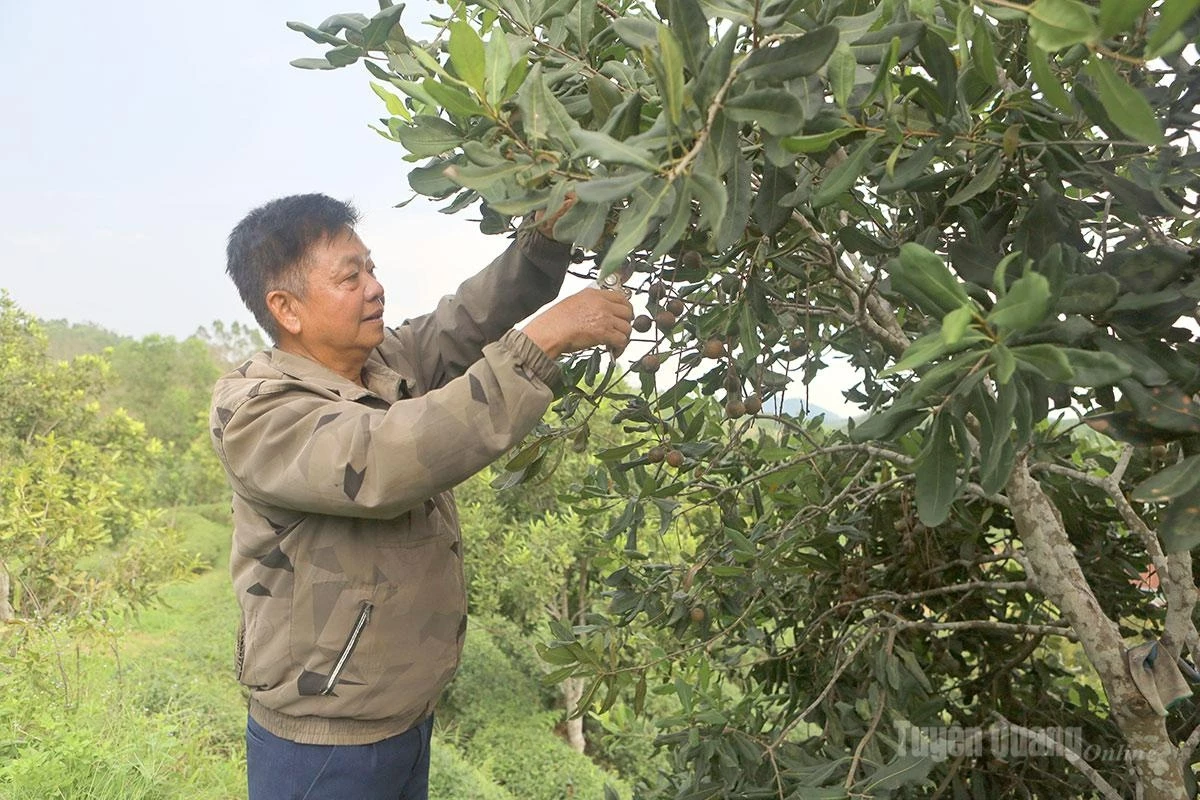 |
| Nguyen Tien Dung tends his macadamia trees. |
In 1996, Dung’s family owned two hectares of Kim Tuyen tea and five hectares of forest. In 2003, he was elected by local people as Party Cell Secretary and head of Lang Ngoi Village, My Bang Commune, and now serves as Secretary of the Ngoi Residential Area Party Cell. Seeking effective ways to boost production and set an example for local people, he began exploring new crops suited to local conditions.
In 2007, when the provincial Department of Agriculture and Rural Development launched a pilot program to grow macadamia trees on tea-growing land, Dung decided to participate. He received 300 seedlings of several varieties, including 842, 695, OC and A38. He planted the macadamia trees among his tea bushes, gradually replacing the windbreak trees that had previously been used.
The seedlings were planted in July, at the end of the rainy season, when the hillside soil was dry and water was scarce. To save the young trees, Dung carried water from half a kilometer away and watered them one by one. Despite his efforts, nearly 40 trees died. Undeterred, he continued tending the surviving trees. After four years, the macadamia orchard produced its first harvest of around 500 kilograms. By 2014, the trees had reached stable growth, with each mature tree yielding an average of seven kilograms of nuts.
According to Dung, the OC variety has performed best on the hillside soil in Ngoi Residential Area. The tall macadamia trees not only provide an additional source of income but also help shield tea plants from strong sunlight and winds, creating favorable growing conditions for the tea crop.
Fresh macadamia nuts currently sell for around VND60,000 per kilogram at the farm. After processing and shelling, the price can reach VND500,000 per kilogram. The crop now brings Dung’s family an additional annual income of approximately VND50-70 million.
However, Dung said expanding the model remains challenging due to the high cost of seedlings, at nearly VND100,000 each, while local farmers have limited land and investment capital. Drawing on his own experience, he hopes that better access to seedlings, capital and stable markets will help macadamia trees realize their potential as a viable economic crop on the area’s hillside land.
Le Duy


READER COMMENTS