
Pioneering a new path to prosperity in Noong Cuong
After a series of setbacks in livestock farming and crop production, Hmong couple Ly Van Mai and Ly Thi Vinh in Bo Ngoang Village, Minh Quang Commune, Tuyen Quang Province, have found a promising new direction with honey pineapple cultivation. The model has not only helped improve their family’s income but also opened up a new production approach for local farmers to learn from and adopt.
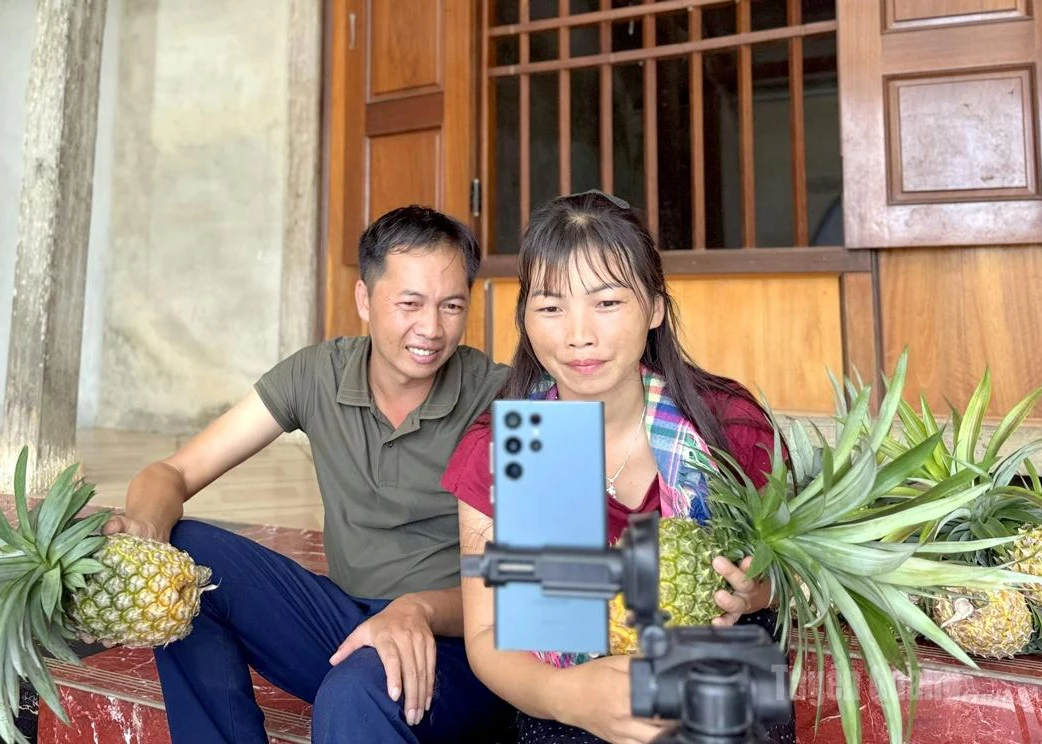 |
| Mai and his wife livestreaming to sell pineapples. |
Born in 1991, Mai has tried various ways to make a living, from growing rice and peanuts to raising pigs, buffaloes and cattle. In 2022, after a period of working away from home, the couple returned to their hometown and borrowed money to invest in raising more than 20 pigs for meat. However, the herd fell ill just before it was ready for sale, leaving the family in serious financial difficulty. They then switched to raising buffaloes and cattle for fattening, but suffered another setback when livestock prices plunged as the animals reached market weight.
These repeated “trial-and-error” experiences taught Mai that farming cannot rely solely on available land and experience. Farmers need to carefully calculate both inputs and outputs while keeping a close eye on market demand.
At the end of 2023, after visiting relatives in Dak Lak Province and seeing the economic potential of honey pineapples, Mai decided to replace part of his sugarcane and peanut fields with pineapple. He initially planted more than 1,000 pineapple plants. After nearly two years of cultivation, the plantation produced large, attractive and sweet fruit, with some pineapples weighing up to 2.5 kg and receiving positive feedback from consumers.
Another distinctive feature of the family’s model is their approach to marketing. Instead of relying entirely on traders, the couple uses a smartphone to livestream, introduce their products and share how the pineapples are grown and cared for. At a selling price of around VND30,000 per kilogram, their first harvest generated nearly VND50 million in revenue, several times higher than what they had earned from previous crops.
Following the first successful harvest, the couple expanded their plantation to more than 3,000 pineapple plants. Mai has also actively shared his experience in selecting varieties, cultivation techniques and online sales with other local farmers. His pineapple field has become a practical learning site where residents can visit, observe and learn from the model.
Ma Van Bo, Secretary of the Bo Ngoang Party Cell, said the couple’s model is opening up a new path to prosperity for local people. Starting with one household willing to experiment, the model is expected to create a ripple effect, gradually fostering new production thinking and encouraging farmers to grow crops that offer higher economic value and respond better to market demand.
Tran Lien


READER COMMENTS