
Pressure from shocks on the global economy
Geopolitical volatility, instability in energy and financial markets, and the growing trend towards trade barriers are placing increasing pressure on the global economy.
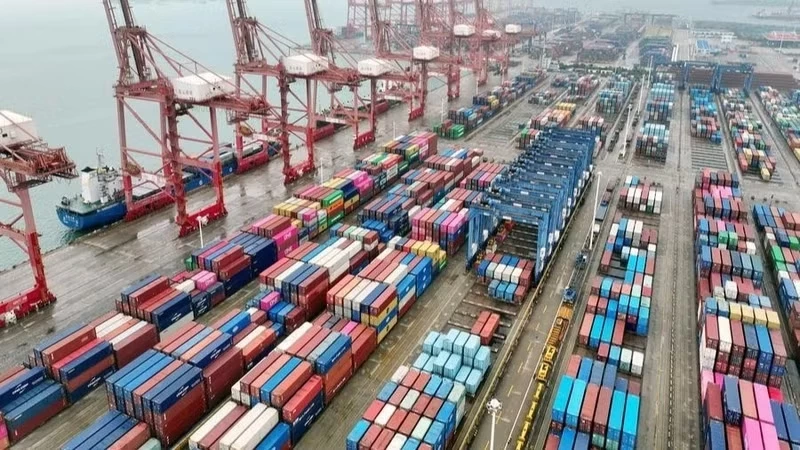 |
| Cargo ships load and unload containers at Lianyungang Port in Jiangsu Province, China. (Photo: XINHUA) |
Geopolitical volatility, instability in energy and financial markets, and the growing trend towards trade barriers are placing increasing pressure on the global economy. In this context, developing countries face an urgent need to diversify supply sources, strengthen domestic production capacity and enhance international cooperation to improve their resilience to external shocks.
The global economy is being heavily affected by geopolitical factors. As conflict hotspots in the Middle East show no signs of easing, considerations relating to energy security, supply chains and strategic competition among major economies are significantly changing the global business environment, increasingly exerting far-reaching impacts on growth, trade and investment prospects.
According to the 2026 Trade and Development Report recently released by the United Nations Conference on Trade and Development (UNCTAD), global economic growth is projected to fall from 2.9% in 2025 to 2.6% in 2026. The rather bleak outlook for the global economy reflects the combined pressures of energy shocks, financial instability and new trade barriers.
Conflicts have driven oil prices sharply higher, increasing energy import costs and placing additional pressure on economies dependent on external supplies, while exacerbating the cost-of-living burden on low-income households.
Developing countries are among those significantly affected due to constraints on financial resources, technology and autonomous production capacity. According to UNCTAD, economic growth in this group of countries is projected to decline from 4.7% in 2025 to 4% in 2026. This shows that although developing economies continue to maintain growth rates above the global average, they cannot remain unaffected by the consequences of shocks.
The impact is most evident in countries dependent on imports of fuel, food and production materials. The difficulties are even more severe in countries with limited fiscal space and heavy public debt burdens. However, geopolitical volatility is also driving the restructuring of supply chains, opening up opportunities to attract investment and develop new industries in countries with strategic locations, favourable business environments and suitable workforces.
The shocks are testing the resilience of the global economy. Diversifying energy supply sources and addressing bottlenecks in supply chains are considered among the key measures to mitigate risks. These are not merely short-term responses but also part of a long-term strategy to ensure economic security. Rather than relying too heavily on a single supplier country, transport route or type of fuel, economies need to build more flexible supply structures by combining diversification of import partners, strategic reserves, improved energy efficiency and the development of domestic energy sources.
In efforts to diversify supply chains, countries need to establish broader networks of partners to increase their ability to substitute supply sources and ensure that essential industries have contingency plans in place when crises occur. In addition, developing countries need to coordinate industrial, financial and technology policies and strengthen links between foreign investment and domestic suppliers, thereby increasing domestic value added and resilience to external fluctuations.
In the long term, an economy's resilience depends not only on its ability to overcome immediate shocks but also on its production structure, technological level and degree of income-source diversification. Therefore, developing countries need to shift from a crisis-response mindset towards building systemic resilience.
In a world tending towards fragmentation, stronger cooperation among developing countries can become an important resource for mitigating risks. For developing countries, expanding trade and developing regional supply chains, alongside coordinating investment in cross-border infrastructure, can help diversify markets, reduce transaction costs and better leverage complementarities between economies. Through regional cooperation mechanisms, countries with small markets can expand their consumer bases, coordinate the development of logistics systems, share crisis-management experience and establish common standards.
UNCTAD's projections show that the global economy is facing numerous interrelated challenges. Geopolitical volatility, energy shocks, trade barriers and financial instability not only create short-term difficulties but also necessitate adjustments to development models. In this context, developing countries need to build resilience from within while maintaining substantive international cooperation in order to turn geopolitical challenges into drivers of innovation and sustainable development.
NDO


READER COMMENTS