The mystery behind the red-hot ploughshare-licking ritual
Amid the cloud-covered peaks of Tay Con Linh Mountain, the Co Lao ethnic community in Ta Chai Village, Tan Tien Commune, Tuyen Quang Province, continues to preserve a unique traditional agricultural ritual: licking a red-hot ploughshare. Beyond its mysterious spiritual elements, the ritual reflects the community’s aspirations for peace, prosperity and abundant harvests, while representing a distinctive part of its cultural heritage.
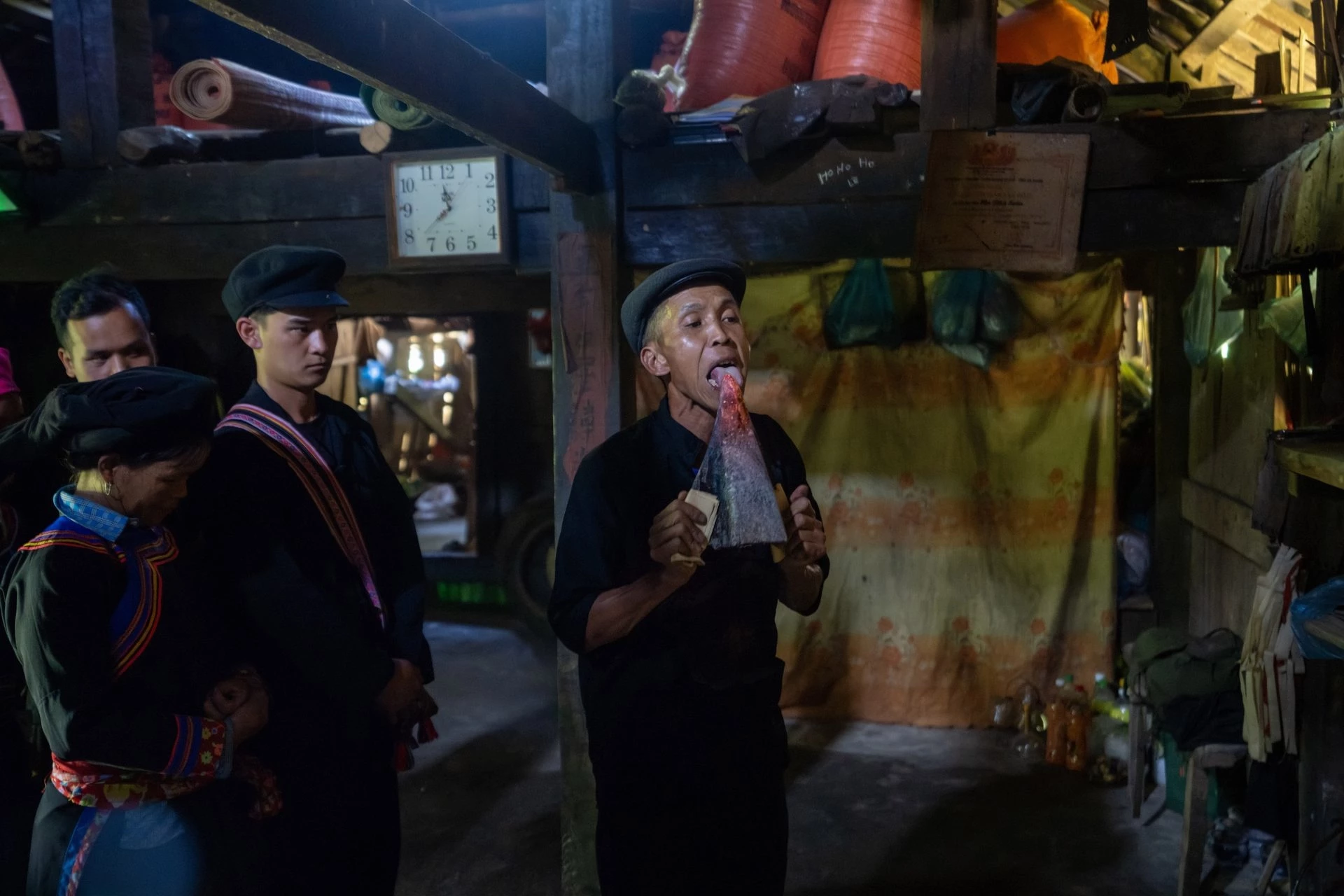 |
| Artisan Min Pha Xoan performs the ritual of licking a red-hot ploughshare. |
The ritual is performed by artisan Min Pha Xoan, one of the few Co Lao people who still possess the knowledge and ability to carry out this extraordinary practice. He is not only a respected member of the community but also a knowledgeable custodian of his ethnic group's customs, folk songs and traditional ceremonies.
For the Co Lao people, an iron ploughshare is more than a farming tool; it holds symbolic significance in their agricultural beliefs. Fire is regarded as a purifying force that drives away evil spirits, illness and misfortune. Through the ritual, the community prays for favourable weather, bountiful harvests, good health and peace in the village.
The ceremony consists of two consecutive stages, known as ‘cung song’ and ‘cung chin’, and features traditional offerings such as a rooster, sticky rice, pork, cooked rice, handmade paper and incense. While the shaman performs prayers to the deities, the iron ploughshare is buried in a brazier of glowing charcoal for several hours. After completing the spiritual rites and reciting traditional incantations, artisan Min Pha Xoan approaches the fire and touches his tongue directly to the glowing-hot metal, leaving onlookers astonished.
The artisan warns that the practice is extremely dangerous and should never be imitated. According to traditional beliefs, it is closely associated with spiritual rites and a special ability that not everyone possesses.
According to Bui Thanh Huong, Vice Chairman of the Tan Tien Commune People's Committee, the ritual is a unique form of agricultural spiritual practice that reflects the Co Lao people's aspiration to overcome the challenges of nature and their wish for plentiful harvests. The local authorities regard preserving the cultural identity of ethnic minority groups as an important task closely linked to socio-economic development.
In the coming time, Tan Tien Commune plans to step up documentation and inventory work to identify and preserve the Co Lao people's intangible cultural heritage. It will also create favourable conditions for respected community members and artisans to practise their traditions and pass on folk knowledge to younger generations. In addition, the commune aims to link heritage preservation with community-based and nature-based tourism development in the foothills of Tay Con Linh Mountain.
Preserving this ritual will not only help safeguard the longstanding cultural values of the Co Lao people but also foster ethnic pride and create new opportunities for tourism and local economic development.
Giang Lam


READER COMMENTS