
Lawmakers mull over changes to architecture law
Lawmakers heard a Government proposal and verification report on the draft Law amending and supplementing several articles of the Law on Architecture during the 16th National Assembly’s first extraordinary session in Ha Noi on August 5.
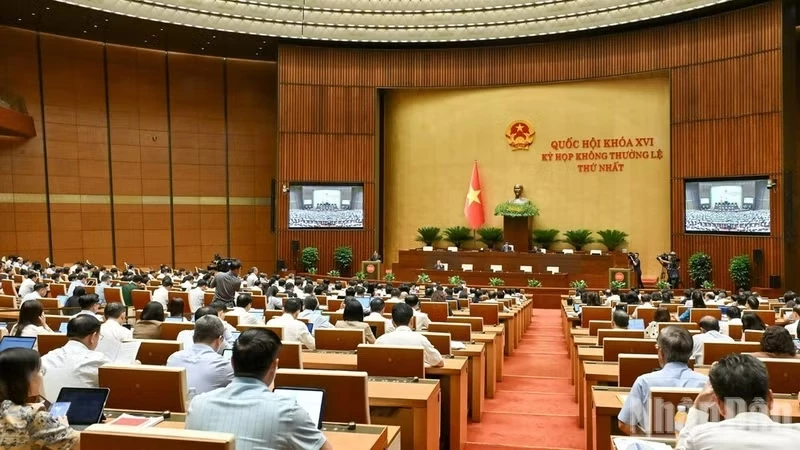 |
| At the 16th National Assembly’s first extraordinary session (Photo: nhandan.vn) |
Defining “national cultural identity in architecture”
Minister of Construction Tran Hong Minh said the draft law would amend or replace 14 articles, scrap four and keep 23 intact.
On architectural management, the draft clarifies the concept of “national cultural identity in architecture”, tying design to the preservation and promotion of regional heritage. It pushes architecture that mirrors local identity and fits each locality’s natural, historical and social conditions, while setting criteria to identify, assess and protect architecturally valuable buildings as a distinct form of cultural heritage.
It also aims to enshrine the Politburo’s Resolution 80-NQ/TW on Vietnamese culture development into law.
The draft upgrades architectural management tools, specifically management regulations and design competitions, to meet demands for lawmaking reform and national development in a new era.
Curbing wastefulness and red tape
Presenting the verification report on the draft law, Chairwoman of the NA Committee for Science, Technology and Environment Nguyen Thanh Hai said the committee largely backs the proposed changes to Article 5.
The committee recommended that the provincial-level People’s Committees issue a set of criteria and a general framework to guide the identification of national cultural identity locally. Commune-level authorities would then simply apply that framework without devising their own separate standards.
It broadly endorsed the proposed authority to issue architectural management regulations under the two-tier local administration model. To ensure feasibility, it urged the Government to consider requiring management regulations only in special, new urban and central areas, not across entire administrative boundaries.
It stressed strict urban design controls of large-scale private real estate projects and lakeside, riverside and coastal zones to protect the broader landscape.
Control mechanisms should be added to lift urban space quality, promote green architecture, improve energy efficiency and adaptation to climate change.
For architecturally valuable buildings, the committee asked drafters to codify core criteria for identification and classification, while clearly defining provincial-level committees’ duties in drawing up, approving, publishing and revising the relevant lists.
It also proposed studying consultation mechanisms that tap professional and social organisations, independent expert councils and local communities before any building is put on the list.
At the same time, mechanisms should be set up to manage and preserve buildings with outstanding architectural value that fall short of heritage recognition criteria, while balancing owners’ interests.
The committee also largely agreed with narrowing the scope of architectural positions that require a mandatory practice certificate, a move designed to cut red tape.
It proposed, however, scrapping the 10-year validity period for architectural practice certificates and instead managing their validity automatically based on professionals’ continuing professional development (CPD) points.
NDO


READER COMMENTS