
Emphasising spirit of benevolence and humanity in treatment of offenders
Continuing the 5th session of the National Assembly Standing Committee on the afternoon of August 18, under the chairmanship of National Assembly Chairman Tran Thanh Man, the committee provided feedback on the draft amended Penal Code; offered opinions on the orientation and policies for the draft amended Law on Organisation of Criminal Investigation Agencies; and discussed the proposal to split the Ninh Thuan nuclear power project into independent projects.
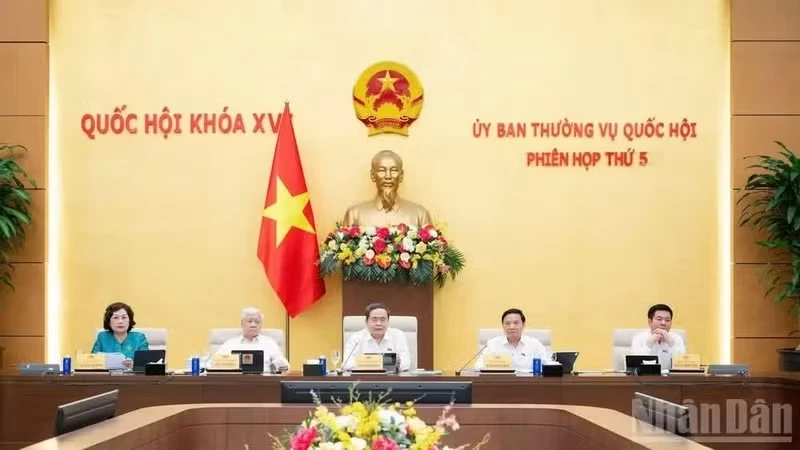 |
| National Assembly Chairman Tran Thanh Man speaks at the 5th session of the National Assembly Standing Committee. (Photo: Dang Anh) |
Deputy Minister of Public Security, Senior Lieutenant General Le Van Tuyen, stated that the drafting of the amended Penal Code aims to further institutionalise the Party’s guidelines and policies regarding national construction, development, and defence in the new context.
It also seeks to address practical obstacles and inadequacies in implementation, thereby effectively contributing to the protection of the political regime, human rights, citizens’ rights, and the legitimate rights and interests of agencies and organisations.
The draft Code comprises 3 parts, 25 chapters, and 415 articles. Compared to the 2015 Penal Code (as amended and supplemented in 2017, 2024, and 2025), the draft removes 8 articles, adds 14 new ones, amends 301 articles, and retains 100 articles unchanged.
The revisions focus on provisions regarding crimes and penalties; the addition of regulations concerning the exclusion of criminal liability, the deferral of criminal prosecution, the exemption from criminal liability, and the statute of limitations for criminal prosecution; and the amendment of existing provisions to ensure consistency, uniformity, feasibility, and proper legislative technique.
Presenting the verification report on the draft law, Phan Chi Hieu, Chairman of the Committee on Law and Justice, stated that the draft code’s contents fundamentally align with and institutionalise the Party’s viewpoints and guidelines.
They further concretise tasks related to judicial reform; the development and refinement of the legal framework for crime prevention and control —emphasising rehabilitation and humanitarian principles in the treatment of offenders; the imperative for breakthroughs in science, technology, innovation, and digital transformation; and the encouragement and protection of officials who demonstrate initiative, boldness, and a willingness to accept responsibility for the common good.
However, given that the Penal Code is a foundational statute, a comprehensive amendment would entail fundamental shifts in criminal policy with significant impacts across all spheres of social life.
Therefore, the verifying body recommends further study and review to ensure the full institutionalisation of the latest viewpoints, objectives, and strategic directions of the Party and State.
Presenting the key contents of the draft Law on the Organisation of Criminal Investigation Agencies (amended), Senior Lieutenant General Le Van Tuyen,Deputy Minister of Public Security, stated that the amendment aims to institutionalise the Party’s guidelines and perspectives on reorganising the state apparatus; to consolidate the system of investigative agencies into a streamlined, professional, high-quality, and effective structure; to refine regulations regarding duties, powers, and investigative jurisdiction; and to resolve practical obstacles and inadequacies.
Summarising the opinions on the orientation and policies, Phan Chi Hieu, Chairman of the Committee for Law and Justice, stated that the committee concurs with the necessity of drafting the law but urges the lead drafting agency to thoroughly review the policies and specific provisions within the draft.
This is to ensure the full, accurate, and timely institutionalisation of the Party’s guidelines, particularly the resolutions of the Third Plenum of the 14th Party Central Committee.
In his concluding remarks on the two aforementioned matters, National Assembly Vice Chairman Nguyen Khac Dinh urged the drafting agencies responsible for the Penal Code (amended), the Criminal Procedure Code (amended), and the Law on the Organisation of Criminal Investigation Agencies (amended) to coordinate their efforts and align their approaches and policies, thereby ensuring a high level of consensus prior to submission to the National Assembly.
The NA Vice Chairman Nguyen Khac Dinh requested that the government continue to study and review the draft Penal Code and solicit broad input from relevant experts, agencies, and organisations, while also ensuring that public opinion is gathered, given that the content concerns human rights and citizens’ rights.
NDO


READER COMMENTS