
Viet Nam pioneers intelligent robots for nuclear safety
Scientists at the Viet Nam Academy of Science and Technology have successfully developed an autonomous robot integrated with a robotic arm, capable of remote monitoring and assisting with operations in nuclear environments.
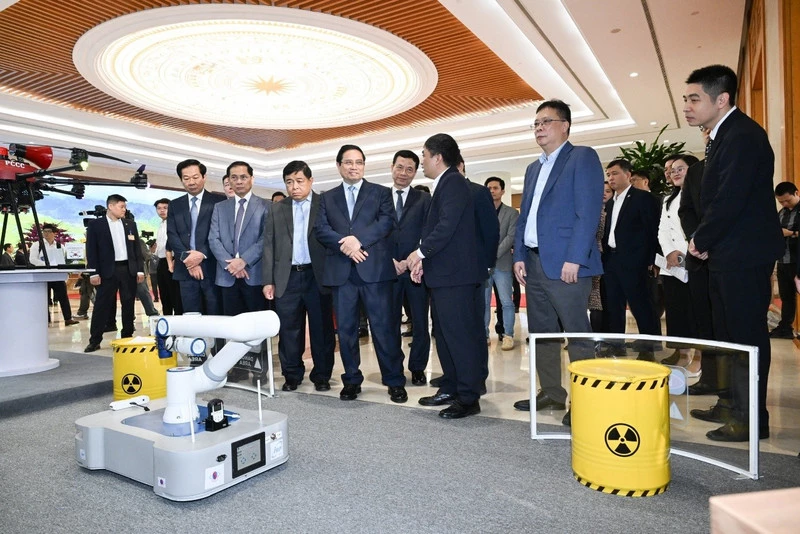 |
| Dr Ngo Manh Tien introduces the robot to Prime Minister Pham Minh Chinh and other delegates at the Third National Forum on Digital Economy and Digital Society, held in Ha Noi in December 2025. (Photo: Viet Nam Academy of Science and Technology) |
This achievement affirms the country’s ability to master intelligent robot technology, opening new directions for radiation safety and nuclear applications in Viet Nam.
In the context of the Fourth Industrial Revolution, intelligent autonomous robots are increasingly deployed across diverse fields such as manufacturing, logistics, monitoring, and hazardous environments. The integration of collaborative robots (cobots) with autonomous mobile robot (AMR) platforms enhances automation, flexibility, and operational efficiency.
Ensuring radiation safety for humans remains paramount in the nuclear industry. Radiation exposure can damage DNA, leading to mutations, cancer, and serious genetic consequences. Applying robots to replace humans in monitoring, operating, and handling radioactive environments is therefore an urgent solution to minimise risks.
Aligned with the Party and State’s policy on restarting the Ninh Thuan Nuclear Power Project and advancing the national nuclear power programme, Resolution No. 189/2025/QH15 has introduced special mechanisms and policies for investment projects. Research and automation technology products, IoT, AI, and robots serving radiation safety monitoring and operational support in nuclear environments hold vital significance for energy security and sustainable development.
According to the scientists, many robot systems worldwide have been developed for the nuclear sector, ranging from radiation measurement and imaging in inaccessible areas to assisting with operations, transport, and incident handling.
Since the Fukushima nuclear incident in Japan, practice has shown that remotely controlled or semi-autonomous robots still depend heavily on humans, communication infrastructure, and terrain conditions, limiting their effectiveness. This underscores the need for a new generation of robots capable of autonomous operation, environmental self-awareness, and proactive decision-making in complex, unpredictable situations.
Mastering intelligent autonomous robot technology in radiation environments not only contributes to ensuring national safety and energy security but also carries strategic significance in strengthening domestic scientific and technological capacity for sustainable development.
In Viet Nam, this requirement is particularly urgent as the country moves to restart its nuclear power programme, exemplified by the Ninh Thuan Nuclear Power Project. Mastering intelligent autonomous robot technology in radiation environments not only contributes to ensuring national safety and energy security but also carries strategic significance in strengthening domestic scientific and technological capacity for sustainable development.
Against this backdrop, the research team led by Dr Ngo Manh Tien from the Institute of Physics under the Viet Nam Academy of Science and Technology implemented the project “Research and Development of Intelligent Autonomous Robots Using Various Sensor Technologies and IoT, AI Platforms for Radioactive Environment Monitoring”.
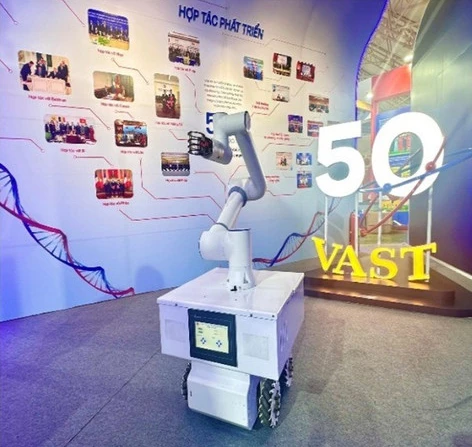 |
| The robot can self-localise, reconstruct its working environment, and attach radiation information to specific map locations. (Photo: Viet Nam Academy of Science and Technology) |
Within the project framework, the team designed an autonomous robot system integrated with a robotic arm, synchronising modern sensors such as Lidar, 2D–3D cameras, IMU, and radiation detectors. The standout feature is not merely mobility or measurement capability, but the processing of comprehensive data to build spatial maps and real-time radiation distribution maps simultaneously.
Using Simultaneous Localisation and Mapping (SLAM) algorithms, the robot can self-localise, reconstruct its working environment, and attach radiation information to specific map locations. This enables operators to quickly identify high-radiation areas, determine safe zones, and track environmental changes during operations.
Notably, the team integrated the autonomous robot with a six-degree-of-freedom collaborative robotic arm and artificial intelligence algorithms, allowing the system to monitor and assist with operations in radioactive environments.
This approach overcomes limitations of previous models and opens potential applications at nuclear facilities, nuclear medicine, and radiation incident response. Tests at the Da Lat Nuclear Research Institute, Ha Noi Irradiation Centre, and several nuclear medicine facilities demonstrated stable operation, accurate positioning in wide spaces with obstacles, and intuitive radiation mapping.
Discussing challenges, Dr Ngo Manh Tien noted that the greatest difficulty lay not in individual components but in integrating them into a synchronised, stable system. The robot must simultaneously localise accurately, avoid obstacles, control the robotic arm to interact with objects, integrate radiation measurement devices, and build real-time radiation maps of the operating area.
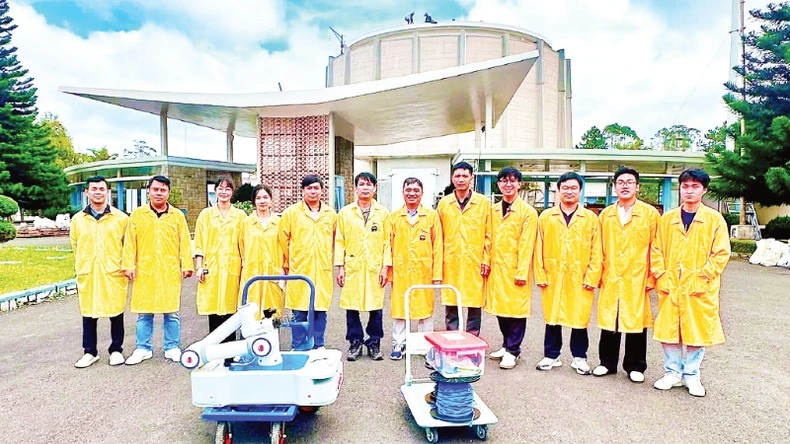 |
| Testing of the robot at the Da Lat Nuclear Reactor. (Photo: TIEN HIEU) |
To meet these demands, the team adopted an approach of “mastering each technology layer” from mechatronic design and kinematic-dynamic modelling to control and perception systems. The core technologies include SLAM, AI-applied navigation, and IoT platforms. In particular, the team developed algorithms combining SLAM with real-time radiation data to create visual maps for monitoring and decision-making. On this foundation, the autonomous robot system with a robotic arm has been progressively perfected for radioactive environments.
According to the research team, these results are only the beginning but already open many application prospects. At nuclear power plants, laboratories, and research centres, the robot can replace humans in inspections, monitoring, and operations in contaminated areas, significantly reducing exposure to hazardous radiation such as alpha, beta, and gamma.
Although initial tests confirm effective operation in radioactive environments, the system requires further refinement to address limitations encountered during trials, advancing towards higher stability and readiness for application. To achieve this, support from the Viet Nam Academy of Science and Technology and the participation of technology enterprises will be crucial, particularly in technical standardisation, manufacturing, and developing application scenarios suited to domestic conditions.
NDO


READER COMMENTS