
Breakthroughs from the two-tier local government model
After one year of implementing the two-tier local government model from July 1, 2025, the northern province of Tuyen Quang has recorded encouraging results in administrative reform, streamlining the political system and improving public services. The reform followed the merger of Tuyen Quang and Ha Giang provinces and the reorganization of commune-level administrative units under Resolution No. 1684/NQ-UBTVQH15 issued by the National Assembly Standing Committee.
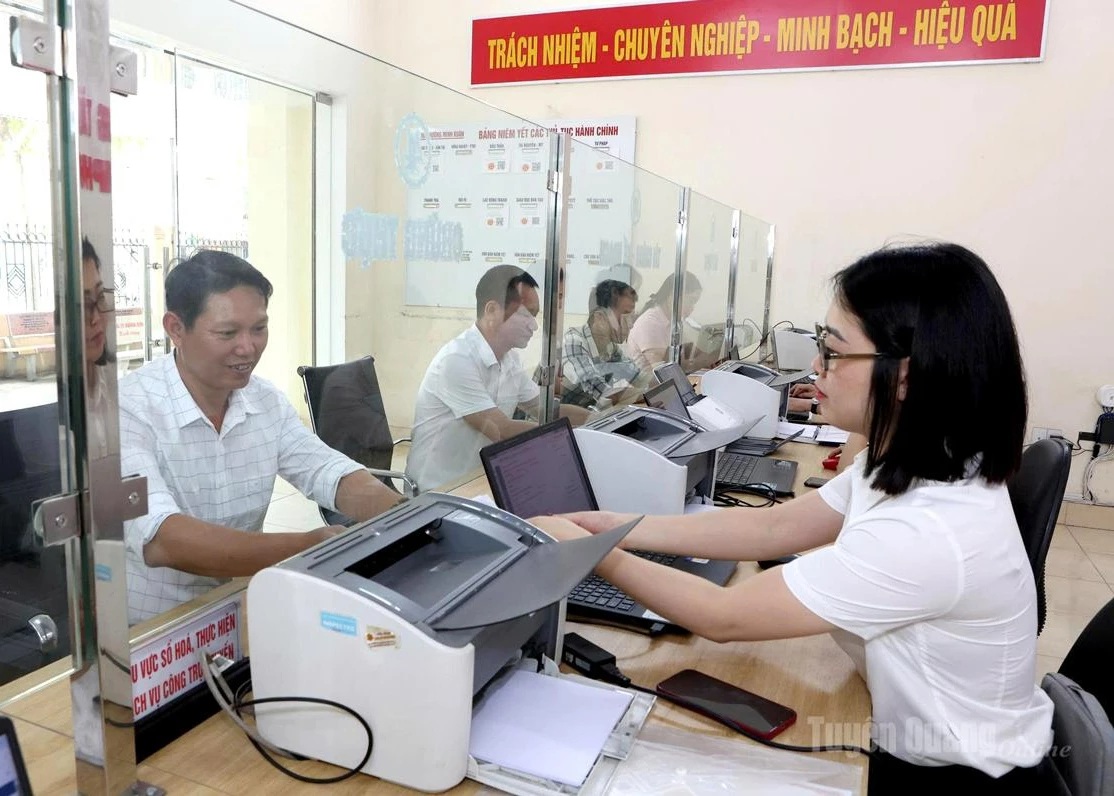 |
| Staff at Minh Xuan Ward Public Administrative Service Center assist residents with administrative procedures. |
Following the restructuring, the province now consists of 124 administrative units, including 117 communes, seven wards and 3,802 villages and residential groups. Within less than a year, provincial authorities issued hundreds of directives, resolutions and plans to reorganize the apparatus, decentralize authority, allocate budgets and arrange personnel.
On the first day of operation, the 19th Provincial People’s Council successfully elected key leadership positions and established 14 specialized departments under the Provincial People’s Committee, reducing 13 agencies compared to the combined structures of the two former provinces. At the grassroots level, all communes and wards have appointed full leadership teams. Notably, all Party secretaries, commune-level People’s Committee chairpersons and heads of inspection commissions are non-local officials, a move aimed at enhancing transparency and preventing local interest groups.
The new governance model has significantly shortened administrative procedures by removing the district level as an intermediary. Public Administrative Service Centers have been established in all 124 communes and wards, with the public satisfaction rate reaching 97.27 percent and more than 99 percent of dossiers processed ahead of schedule at the commune level.
The province has also delegated 722 tasks to commune-level authorities across sectors including finance, justice, education, culture and healthcare. Digital transformation has been accelerated, with 100 percent of official documents exchanged electronically among state agencies and the administrative system connected to 24 national databases.
Despite these achievements, the province still faces major challenges, including a shortage of more than 4,500 civil servants and public employees, as well as uneven digital infrastructure in remote areas. For the 2026–2030 period, Tuyen Quang plans to continue refining decentralization policies, strengthen grassroots personnel training, upgrade digital infrastructure and further improve the efficiency of the two-tier government model toward a leaner, more modern and citizen-centered administration.
Ly Thu

READER COMMENTS