
Europe’s autonomy challenge
New developments related to the conflict in the Middle East, together with rifts within the North Atlantic Treaty Organisation (NATO), have confronted European countries with an unavoidable reality: being protected by a security umbrella does not necessarily mean enjoying sustainable safety.
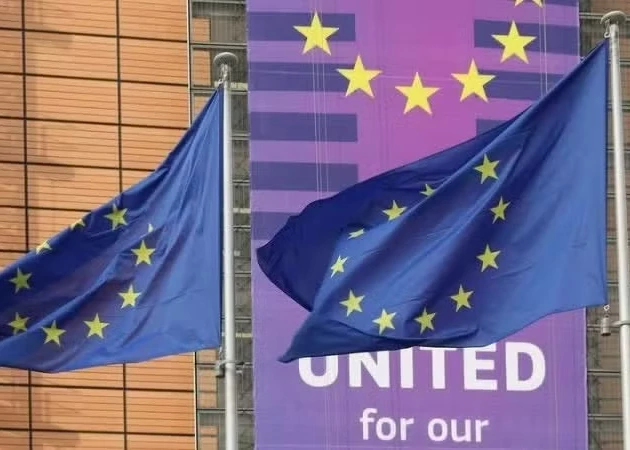 |
| The European Union flag flies outside the Berlaymont building, headquarters of the European Commission, in Brussels, Belgium, on January 29, 2025. (Photo: Xinhua) |
Strategic autonomy has therefore become an inevitable and urgent requirement for the Old Continent, rather than merely a political declaration.
The security landscape of Europe in general, and of the European Union (EU) in particular, is caught in a difficult position amid pressure from various directions: the prolonged conflicts in Ukraine and the Middle East; economic and political volatility within countries due to high public debt, soaring energy prices, and their impact on people’s lives; and, most notably in recent times, the growing distance from the US, Europe’s key ally across the Atlantic.
In this uncertain security environment, strategic autonomy, from a development-oriented concept raised by European leaders several years ago, has gradually become a matter of survival.
The US “security umbrella” for Europe has been increasingly shaken by deep differences in views over the conflict in the Middle East. Beyond criticising European allies for “failing to act” in this conflict, US President Donald Trump has ordered the Pentagon to withdraw about 5,000 US troops from Germany. He has also left open the possibility of reducing the number of US troops stationed in Italy and Spain.
The close alignment between NATO allies and the US seen in the wars in Afghanistan and Libya has not been replicated in the current war in Iran. This reflects deep differences in strategic objectives. Washington sees the Middle East as a vital region for maintaining its position and influence and is therefore seeking to assert control over the conflict there, including control of the strategic maritime route through the Strait of Hormuz.
Europe, meanwhile, wants to avoid being drawn deeper into the war in the Middle East, a conflict outside Europe but one that has caused many economic, security, and social consequences for the continent, while failing to gain support from international public opinion. Europe also seeks to stabilise energy security, an issue that previously plunged the region into turmoil due to the impact of the conflict in Ukraine.
The US plan to withdraw troops was something German officials had anticipated. Following Washington’s move, German Defence Minister Boris Pistorius called on Europe to further strengthen its defence capabilities, stressing that “Europe must shoulder more responsibility for its own security.”
Recently, Germany has expanded its armed forces, accelerated defence procurement and infrastructure development, and set a target of increasing the number of active-duty soldiers in its military to 260,000. Since transatlantic alliance relations were shaken over the Greenland issue, the EU has sent a message of stronger unity to protect its member states.
In the field of space defence, the European Commission is expected to allocate 10.6 billion EUR to build a new security satellite system, with the goal of completing it by 2030.
However, between the ambition of strategic autonomy and the reality of action lies a wide gap, in which the cost question remains particularly difficult. Developing technology or procuring defence equipment requires major financial resources, forcing many countries to find a balance between resources for defence and security autonomy, social welfare, and economic development.
Despite recent tensions, German Chancellor Friedrich Merz has stated that Berlin will continue to maintain close cooperation with Washington. The transatlantic relationship remains an important factor for the EU’s future, but the US decision to withdraw troops reflects a profound shift in Washington’s approach to this relationship, where strategic interest calculations are increasingly overshadowing long-term commitments.
In the new period, Europe stands between two currents: on one side, maintaining relations with a key ally; on the other, adjusting its strategy and soon resolving difficulties in order to strengthen its autonomy and capacity for independent action in a volatile world.
NDO


READER COMMENTS