
The challenge of maintaining energy flow
Disruptions in the Strait of Hormuz, a key global energy shipping route, are causing a sharp decline in global oil flows. Major Gulf oil producers are considering diverting exports through alternative routes outside the Strait of Hormuz, while the Organisation of Petroleum Exporting Countries and its partners (OPEC+) have agreed to increase production quotas to alleviate supply pressure on the oil market.
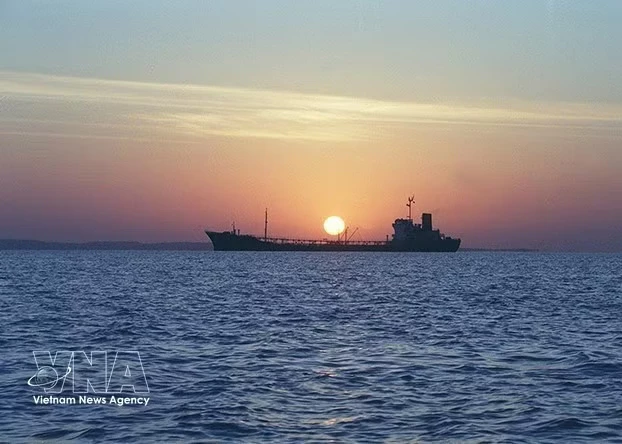 |
| An oil tanker anchored off Qeshm Island in the Strait of Hormuz. (Photo: Middle East Eye/VNA) |
Conflicts in the Middle East have led to a blockade of the Strait of Hormuz, paralysing exports from OPEC+ member countries, including Saudi Arabia, the United Arab Emirates (UAE), Kuwait, and Iraq.
The disruptions are severe, with exports from Saudi Arabia falling to 4.39 million barrels per day, the UAE to 2.13 million barrels per day, and Iraq to only 561,000 barrels per day. Meanwhile, the other two Gulf nations, Kuwait and Qatar, have virtually disappeared from the export map.
Crude oil exports by sea from Gulf countries (excluding Iran) in March fell by 49% compared to the previous month before the conflict. While alternative routes are insufficient to compensate, Gulf countries must quickly develop "Plan B" solutions for oil and gas flows by diverting exports through the Red Sea, utilising ports outside the Strait of Hormuz, or restoring shipping routes from Iraq via Türkiye and Syria.
The current conflict is forcing Gulf countries to reconsider the construction of new pipelines to avoid the “bottleneck” through the Strait of Hormuz in order to maintain stability in oil and gas export flows.
Saudi Arabia clearly recognises the strategic value of the 1,200km East-West pipeline to the port of Yanbu on the Red Sea, which completely bypasses Hormuz. In the context of the current conflict, this pipeline has become a vital lifeline, transporting approximately 7 million barrels of oil per day, and is currently the primary route being utilised.
Saudi Arabia is considering developing additional export ports on the Red Sea coast, including a deep-water port to serve the Neom project. Meanwhile, the UAE is considering the most feasible option at this time: expanding the East-West route and the existing pipeline from Abu Dhabi to Fujairah Port, thereby increasing transport capacity without building complex cross-border infrastructure.
Regional officials and business leaders believe that new pipelines may be the only viable solution currently available to reduce the long-standing dependence on the easily disrupted shipping route through the Strait of Hormuz.
The oil market has already experienced five weeks of significant volatility due to the confrontation between the US-Israel military alliance and Iran. Concerned that attacks on energy infrastructure would increase volatility in the oil market and negatively impact global supply, OPEC+ members recently agreed to increase oil production quotas by 206,000 barrels per day starting in May
However, this is a modest, largely symbolic increase as key OPEC+ members are unable to actually increase production due to the impact of the conflict between the US and Israel on Iran. Furthermore, this quota increase is negligible, representing less than 2% of the supply disruptions caused by the blockade of the Strait of Hormuz.
Given the tight flow of crude oil from the Gulf, major producers such as Saudi Arabia, the UAE, Iraq, and Kuwait are forced to cut supply, so OPEC+’s decision is largely theoretical, intended to highlight their intention to restore production as soon as the conflict subsides.
Despite increasing production quotas, OPEC+ also emphasised the vital importance of protecting international sea lanes to ensure uninterrupted energy flows.
Although Gulf countries have attempted to implement temporary solutions to maintain the flow of oil exports, after more than a month of conflict, alternative transport routes such as pipelines and land corridors in the region are only operating at about 40% of their normal capacity, unable to replace the central role of the Strait of Hormuz. In reality, as long as the Hormuz “bottleneck” remains unaddressed, the global “energy choke” will continue to create significant challenges in maintaining oil supplies.
NDO


READER COMMENTS