
Europe rolls out new entry/exit system: a historic turning point
The new Entry/Exit System (EES) will be fully implemented across Europe’s passport-free Schengen Area from April 10, marking a historic turning point in border management.
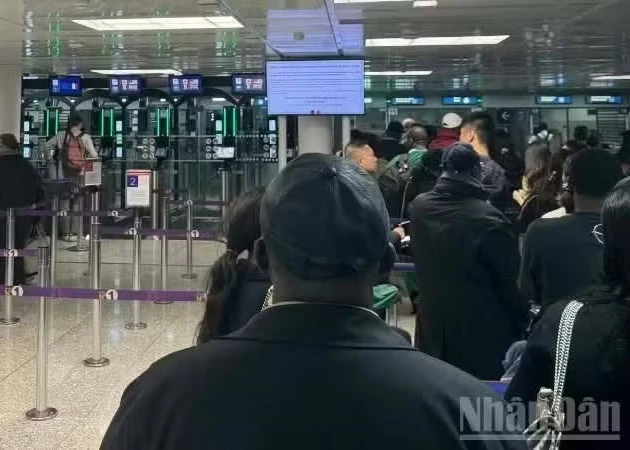 |
| Passengers queue for immigration at Charles de Gaulle Airport, France. (Photo: Nhan Dan) |
This reform, long regarded as both a source of pride and a symbol of Europe’s unity and integration, not only helps close security gaps but, more importantly, strengthens and safeguards the continent’s core values.
Launched in October last year and gradually introduced at border crossings throughout the Schengen Area, the EES uses digital technology to enhance management efficiency and ensure security.
It records data on non-EU travellers entering the bloc, including names, passport numbers, facial biometric images and fingerprints.
This forms part of a broader overhaul of the Schengen system to meet the demands of a new era, after the Schengen Agreement was repeatedly criticised as Europe’s Achilles heel due to significant security loopholes.
More than a technical change, replacing traditional passport stamps with fingerprint registration symbolises the Schengen Area’s strategic vision, in which digital data and cybersecurity measures become Europe’s line of defence
The “digital border” offers multiple benefits. First, the EES is expected to reduce processing times, as travellers only need to register during their first entry into the area. Second, it enables authorities to better manage and flag cases involving forged documents or overstays.
Over more than four decades of development, the Schengen Area, with its open borders, has been regarded as one of Europe’s proudest achievements, embodying unity and delivering substantial economic and tourism benefits.
It is also seen globally as a successful model of integration. However, this success has not been without controversy.
During the 2015-2016 migration crisis, the Schengen Agreement faced intense scrutiny, as security gaps allowed extremist gunmen to move freely within the bloc, placing regional security on high alert. The COVID-19 pandemic further threatened the agreement, as countries reinstated national border controls to contain the virus.
At such moments, each reinstated border check was seen as eroding one of Europe’s flagship integration projects. Reforming the Schengen framework to make it more robust, including accelerating digitalisation and applying biometric technologies in border control, became an urgent necessity. This is particularly significant as Europe now faces renewed migration pressures from the Middle East amid escalating conflicts.
Nevertheless, the reform effort faces notable challenges. Some critics argue that the collection of biometric data constitutes an intrusion into personal privacy, raising concerns about data protection and security.
Another issue is the potential for congestion at airports and railway stations during the initial rollout, as checks on non-EU travellers may slow processing.
The French Airports Association has noted that the technology is not yet fully stable. During trial phases at Grenoble Airport in France, authorities even had to use a car park as a temporary waiting area for passengers undergoing registration.
Despite these shortcomings, Europe views the implementation of the EES as a step in line with broader trends, positioning digital technology as an effective tool. The reform of the Schengen system also reflects a unity of political will, resources and policy among European countries to eliminate risks that could undermine the agreement.
NDO


READER COMMENTS