
Modest budget signals a highly challenging year for the United Nations
The United Nations General Assembly has just approved the organisation’s regular budget for 2026, totalling 3.45 billion USD. This modest budget signals an extremely challenging year ahead for the world’s largest multilateral organisation, requiring it to manage resources with great care to cover its expenditures.
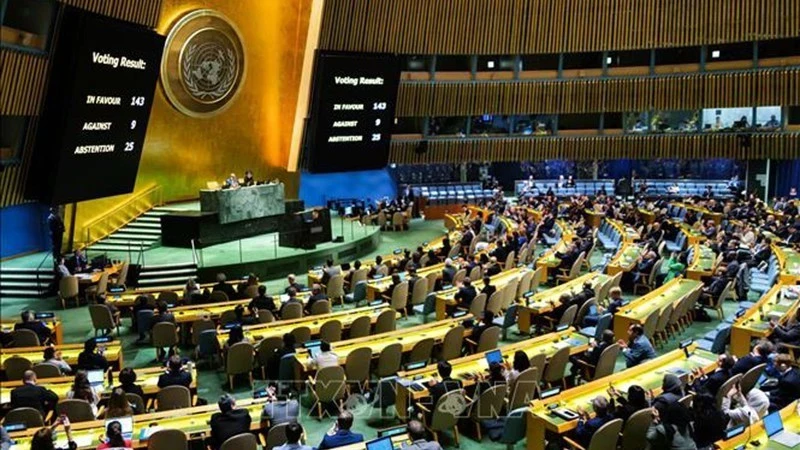 |
| The tight budget has made negotiations over the allocation of funds for United Nations operations particularly tense. (Illustrative image) |
The tight budget has made negotiations over the allocation of funds for United Nations operations particularly tense. Member states have engaged in fierce debates over the size and scope of the budget, including staff cuts, funding for missions, and resources for reform priorities. Talks became increasingly heated amid concerns regarding cash shortages, delayed payments, and incomplete contributions from member countries.
The budget level was approved following a proposal by United Nations Secretary-General Antonio Guterres, which included a 15% reduction in operational costs and a 19% cut in staffing. Guterres argued that, under such financial constraints, United Nations bodies must improve their efficiency, reduce overlap, and adjust staffing levels to better match assigned mandates.
United Nations Controller Chandramouli Ramanathan announced that the organisation would streamline 2,900 staff positions, with the plan to be implemented from early 2026.
Against the backdrop of the United Nations’ financial difficulties, the United Arab Emirates (UAE) pledged a contribution of 550 million USD to support millions of people affected by conflict, famine, and displacement. The UAE reaffirmed its commitment to active cooperation with the United Nations and to delivering aid in a swift and effective manner. The Middle Eastern country has provided a total of 102 billion USD in assistance over many years.
The UAE’s pledge has been highly praised by international partners. World Health Organization Director-General Tedros Adhanom Ghebreyesus stressed that the funding would help sustain health services and save millions of lives. World Food Programme Executive Director Cindy McCain also welcomed the support, affirming readiness to cooperate in delivering timely aid to communities facing severe hunger.
Following the UAE’s move, the US also pledged 2 billion USD for United Nations humanitarian operations. The commitment came after the administration of US President Donald Trump significantly scaled back international aid spending, while many other Western donors have also tightened their budgets. The US State Department did not provide details on how the 2 billion USD would be allocated, nor whether Washington would make additional funding commitments in the near future.
A paradox frequently highlighted by international organisations in 2025 is that funding for humanitarian activities has continued to shrink, while arms purchases and defence spending have expanded steadily.
According to United Nations statistics, global military expenditure in 2025 surged to 2.7 trillion USD, nearly 10% higher than the previous year, 13 times greater than total development aid, and equivalent to the combined GDP of all African countries. In this context, the United Nations Secretary-General has called on world leaders to “take serious action” and increase investment in hunger eradication and poverty reduction, rather than spending on war.
NDO


READER COMMENTS