
A significant turning point for Syria
In early December 2025, Syria welcomed several positive signals on its path towards reconstruction and reintegration. From a country devastated by war and isolated diplomatically and economically, Syria is taking steps that demonstrate its determination to pursue stability, while maximising foreign aid and striving to balance relations with major powers and regional countries.
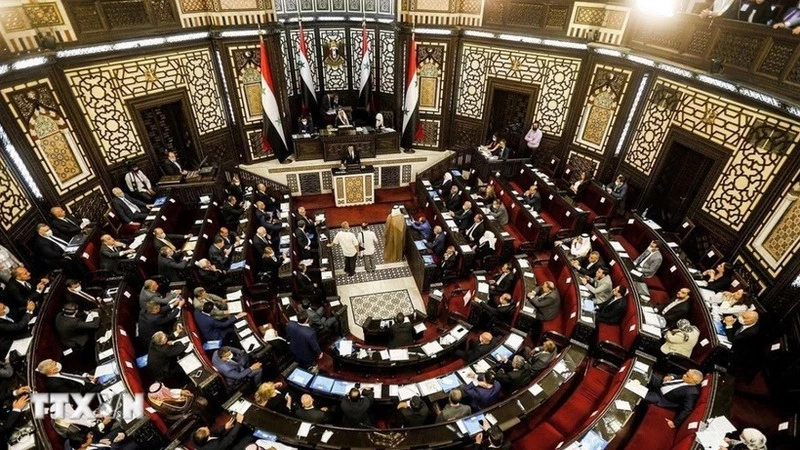 |
| A plenary session of the Syrian Parliament in the capital city of Damascus. (Photo: SANA/VNA) |
The legitimacy of the Syrian government can only be recognised by the international community through its ability to improve the lives of its citizens. On December 4, a delegation of the United Nations Security Council (UNSC) arrived in Syria, marking the first official visit of this body to the Middle Eastern nation after more than a decade of conflict.
According to representatives of the UNSC, the mission conveyed the international community’s expectations regarding a comprehensive transition, inclusive growth, and counter-terrorism efforts in the country.
Canada has recently announced its decision to remove Syria from the list of state sponsors of terrorism. The UK and the US have also allowed Syria to reopen its respective embassies. One year has passed since the fall of former Syrian President Bashar al-Assad on December 8, 2024.
It is undeniable that Syria is entering a more stable trajectory, with broader development opportunities compared with the period of sanctions and isolation. From organising the National Dialogue Conference and issuing the Constitutional Declaration to restoring relations with regional countries and receiving the lifting of sanctions from several states, these developments show the new government’s efforts to re-establish political structures and revive the economy
Nevertheless, the positive progress cannot overshadow the challenges confronting Syria. After more than a decade of civil war, serving as a battleground for regional and international power rivalries, the country faces deep internal and external divisions.
The future trajectory of this Middle Eastern nation is closely tied to the “strategic chessboard” of the US, Russia, Turkey, Iran, Israel, and others, each pursuing its own calculations of interest to expand influence in the Middle East.
Several months ago, when the US announced the lifting of sanctions on Syria, experts noted that the decision was not an impulsive move by Washington, but a strategic adjustment based on political developments within Syria.
The US recognised that sanctions had not produced the intended outcomes, while the new Syrian government was making efforts to advance reforms and regain international trust.
Lifting sanctions is a way for the US to maintain its influence in the Middle East and aligns with broader trends, as the United Kingdom and the European Union (EU) had earlier announced the removal of certain sanctions on Syria.
Syria is now pursuing a balanced diplomatic policy with major powers, while seeking to address security issues with neighbouring countries. Ethnic tensions remain one of Syria’s most difficult-to-solve challenges.
Years of conflict have deepened ethnic divisions, making it extremely difficult to establish unified governance of factions. Syrian authorities are currently investigating an ethnic-violence incident in Sweida Province in the south, which occurred in July and resulted in hundreds of deaths
The more than decade-long civil war has also turned Syria into fertile ground for the self-proclaimed Islamic State (IS) to operate. According to the Syrian Observatory for Human Rights (SOHR), since the beginning of 2025, IS militants have carried out 215 attacks in eastern and north-eastern areas of the country, killing nearly 100 people.
With numerous challenges ahead, Syria’s future remains an intricate puzzle. The solution requires not only the country’s own efforts in reform, national reconciliation and reconstruction, but also cooperation and support from the international community. Public opinion hopes that Syria will seize the opportunities available to rise again from the ashes of war.
NDO


READER COMMENTS