
Creating sustainable growth momentum from dual transformation
The target of double-digit growth is placing Viet Nam’s economy under pressure to grow faster, but it can no longer continue relying mainly on capital, low-cost labour and resource exploitation.
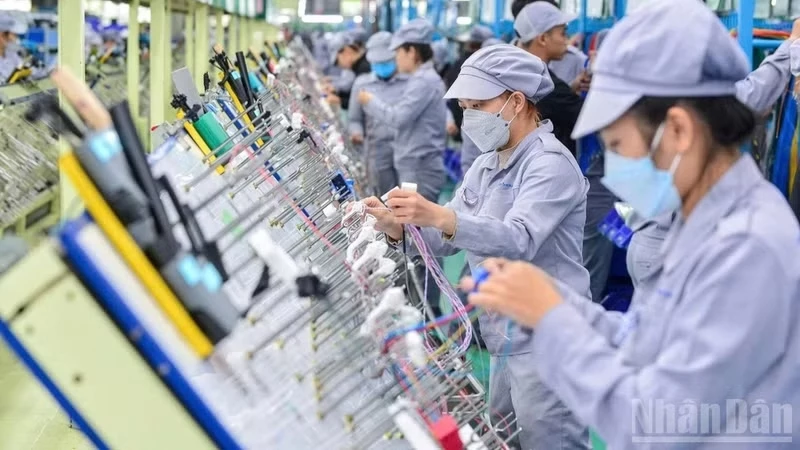 |
| Vietnamese businesses are gradually transforming towards greener operations and deeper digitalisation. (Photo: THANH DAT) |
In this process, dual transformation, comprising digital transformation and green transformation, is not only a requirement for adaptation but must also become a driving force, helping businesses strengthen resilience and competitiveness while laying the foundation for a fast-growing, green and sustainable economy.
The question is how commitments to transformation can be turned into concrete programmes, targets and resources, thereby narrowing the gap between policy and implementation.
Removing bottlenecks
Resolution No. 19-NQ/TW dated July 28, 2026, of the third plenum of the 14th Party Central Committee on renewing Viet Nam’s development model requires a strong shift from growth based mainly on capital, labour, resources and outsourcing to growth based on science, technology, innovation, digital transformation and high labour productivity. The Resolution sets the target that by 2035, Viet Nam will form an efficient, innovative, green, self-reliant, inclusive and integrated economic model, with Vietnamese enterprises capable of mastering technology and holding important positions in modern industries, value chains and development ecosystems.
This orientation places businesses at the centre of the process of renewing the development model. However, if the ways businesses produce, manage and create value do not change, new drivers such as science, technology, innovation and dual transformation will find it difficult to translate into productivity and competitiveness.
Speaking at the 2026 Viet Nam Corporate Sustainability Forum (VCSF), Professor Dr Nguyen Xuan Thang, Chairman of the Central Theory Council, emphasised that changes in the business development model reflect changes in the country’s economic development model. The quality of the development model must be tested through results at enterprises. Businesses that want to grow must innovate; those that want to go far must be creative; and those that want to develop sustainably must continuously renew themselves. Therefore, renewing the economic development model needs to be concretised through renewing the business development model. However, businesses cannot be expected to step into the future if institutions only create conditions and advantages for old ways of doing things.
It is therefore necessary to create controlled testing spaces for businesses; distinguish risks in research and business failures from acts of fraud and legal violations; and, at the same time, accept reasonable risks that are difficult to avoid in innovation. The true measure of enabling institutions lies in the real development opportunities they open up for businesses.
In reality, Vietnamese businesses are gradually transforming towards greener operations and deeper digitalisation. Numerous large enterprises, exporters and businesses participating in global supply chains have proactively invested in business upgrading, automated production lines, energy management, traceability, emissions measurement and information disclosure in line with environmental, social and governance (ESG) criteria.
However, the pace of transformation remains uneven. Many small enterprises are still hesitant because of cost concerns, while finding it difficult to assess efficiency and see the short-term benefits of transformation. Constraints in finance, technology, governance and human resources also make it harder for them to meet increasingly stringent requirements on the environment, traceability and international standards.
Despite numerous commitments to greening and digitalisation, many enterprises still do not know where to start, how much to invest or how to measure results. Therefore, dual transformation has yet to take root in a substantive way at some enterprises.
From commitment to implementation capacity
The urgent requirement now is for businesses to move from a mindset of making commitments to building the capacity to implement them. To access resources for transformation, businesses need clear strategies, specific targets, reliable data, financial plans and the ability to demonstrate effectiveness.
According to Le Hoang Minh, Executive Director of Production at Vinamilk, businesses do not necessarily have to start with major projects. Emissions inventories, energy optimisation, the selection of appropriate technologies and changes in operating methods can all serve as initial steps. This is a practical approach to sustainable development: it does not need to begin with grand statements, but with visible changes in each factory, each production line and each stage of governance. What matters is that results must be measurable, verifiable and scalable.
Nestlé Viet Nam General Director Binu Jacob shared that sustainable development is only substantive when it is linked to the interests of every link in the value chain. Green transformation is both a responsibility and an opportunity to enhance competitiveness and create a foundation for long-term growth.
In the Central Highlands, through the NESCAFÉ Plan, Nestlé has accompanied farmers in improving farming methods, providing seedling support, saving water through efficient irrigation and applying the 4C sustainability certification standard. To date, more than 23,000 households have adopted the programme, helping save 40-60% of irrigation water and reduce fertiliser and pesticide use by around 20%.
From the requirement to reduce environmental impacts, the transformation process has become linked with productivity, quality and producers’ livelihoods. This model shows that transformation can only generate wider impact when implemented across the entire chain. Lead firms need to share standards, data, technology and experience with partners, especially small- and medium-sized enterprises.
Nguyen Quang Vinh, Vice Chairman of the Viet Nam Chamber of Commerce and Industry (VCCI) and Chairman of the Viet Nam Business Council for Sustainable Development (VBCSD), said that for dual transformation to become substantive, the state needs to continue improving institutions, energy infrastructure, digital infrastructure and data, pilot mechanisms and appropriate financial instruments. Businesses must proactively enhance their capacity, starting with measuring consumption, standardising data, improving processes and selecting suitable technologies.
Financial institutions need to assess transformation projects based on their ability to generate cash flow and long-term competitiveness, rather than relying only on collateral. Dual transformation is meaningful only when it changes business capacity. Only when businesses translate the requirements of greening and digitalisation into concrete changes in production and governance can dual transformation become a new driver of growth, while laying the foundation for sustainable national economic development.
NDO


READER COMMENTS