Vietnamese NA helps build institutional foundations for long-term development: Canadian researcher
Viet Nam’s National Assembly plays a key role in institutionalising development orientations and strengthening the political and legal foundations for long-term growth of the country, according to Assistant Professor Joe Pateman from York University in Canada, a researcher in politics and international political economy.
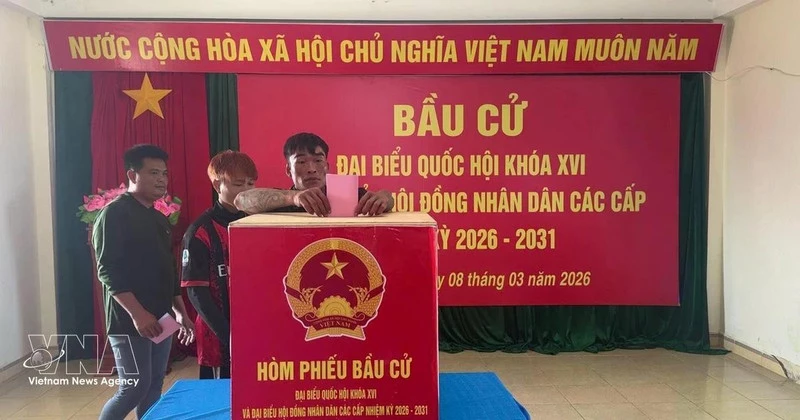 |
| Fishermen cast their ballots at the Da Le polling station in Truong Sa special zone of Khanh Hoa province. (Photo: VNA) |
In an interview granted to the Viet Nam News Agency (VNA)'s correspondent in Canada ahead of the election of deputies to the 16th National Assembly and People’s Councils at all levels for the 2026–2031 tenure, Pateman described the upcoming election as an important political event that helps reinforce governance mechanisms, enabling the State to mobilise public participation in national governance and development.
Assessing the role of the Vietnamese legislature in institutional reform and economic development in recent years, he said the NA has held a pivotal role in translating policy orientations and development strategies into concrete legal frameworks.
The legislative body has helped build and refine the legal system governing Viet Nam’s socialist-oriented market economy, creating a more favourable environment to attract both domestic and foreign investment while improving state governance, he said.
The expert noted that through the adoption of laws on economic management, investment, enterprises and public administration, the legislature has contributed to establishing a stable institutional framework that supports economic growth and deeper international integration of Viet Nam.
He observed that beyond its legislative role, the NA has also coordinated policies and overseen law enforcement, ensuring socio-economic policies are implemented effectively and aligned with the country’s long-term development goals.
According to Pateman, the election of deputies to the 16th NA and People’s Councils at all levels serves to renew and consolidate institutional mechanisms while encouraging public participation in governance and national development.
Under the leadership of the Communist Party of Viet Nam (CPV), the election helps strengthen the connection between the Party, the State and the people, while enabling state institutions to continue improving the legal framework and supervising policy implementation, he said.
As Viet Nam continues its transition and deeper integration into the global economy, political stability, Pateman emphasised, is one of the key factors enabling Viet Nam to maintain strong economic growth and pursue long-term development objectives.
Looking ahead to the next term, he suggested that issues related to economic sovereignty, development of strategic industries and social stability are likely to feature prominently on the NA’s agenda.
The NA may prioritise policies aimed at enhancing national industrial capacity, managing foreign investment flows and promoting strategic industries, he said, adding that poverty reduction, expansion of social welfare systems and improvements in public governance are also expected to remain key priorities to ensure that economic growth goes hand in hand with social stability.
The researcher noted that the NA is working to strengthen legal and institutional frameworks to protect Vietnam’s socialist-oriented market economy and improve its adaptability to global economic and geopolitical changes.
Pateman also highlighted the role of parliamentary diplomacy in Viet Nam’s foreign policy, saying that it is a vital channel for strengthening understanding and cooperation between the country with international partners.
Greater cooperation between the Vietnamese NA and other legislatures, including the Canadian Parliament, could facilitate policy dialogue, legislative exchanges and joint initiatives in many fields, he stressed, noting that under the CPV’s leadership, parliamentary diplomacy serves as a complementary channel to state diplomacy, helping build long-term and stable foundations for cooperation.
According to the expert, there are significant opportunities to deepen parliamentary cooperation between Viet Nam and Canada through exchanges between lawmakers, policy dialogue forums and promoting cooperation in trade, technology and sustainable development. Such cooperation would enhance mutual understanding while creating favourable conditions for expanding economic and trade relations between the two countries, he said.
As Viet Nam continues to diversify its international partnerships, stronger legislative cooperation with partners such as Canada could help build a more balanced, stable and constructive bilateral relationship in the future, the expert added.
NDO


READER COMMENTS