Breakthrough opportunities for Viet Nam’s new seafood product
Viet Nam’s tilapia exports are recording breakthrough growth, with the US market playing a leading role and posting triple-digit expansion in 2025.
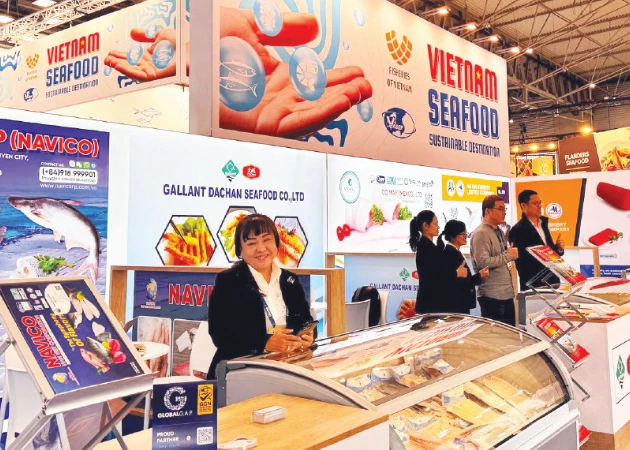 |
| Vietnamese seafood products showcased at Seafood Expo Global in Spain. (Photo: THANH MAI) |
Amid volatility in global seafood export markets, tilapia is emerging as a strategic product for Viet Nam to diversify its export portfolio and enhance sustainable value creation.
Recently, the Ministry of Agriculture and Environment, together with a delegation from the Embassy of the United States in Viet Nam, held discussions to implement the “US–Viet Nam Aquaculture Value Chain Partnership” project. Under the plan, the US side will invest more than 15.2 million USD over five years. The project aims to raise the cumulative tilapia output to 1.21 million tonnes, generating total sales of 1.25 billion USD. Beginning in March 2026, the project will be implemented in the Red River Delta and Mekong Delta, with an expectation of directly benefiting more than 24,000 people, including farming households, aquaculture farms, and processing plants.
Assessing the significance of the project, Phung Duc Tien, Deputy Minister of Agriculture and Environment, described it as a timely and well-targeted move, providing important resources to realise the tilapia development plan through 2030. The project is expected to strengthen the value chain while further expanding tilapia trade to the US, European markets, and the domestic Vietnamese market.
Market analyst Phuong Linh from the Viet Nam Association of Seafood Exporters and Producers (VASEP) noted that tilapia export turnover to the US in 2025 surged by 173% compared with 2024, earning more than 53 million USD and making the US the largest importer of Vietnamese tilapia. With total tilapia export value hitting 99 million USD in 2025, up more than 140% year on -year, Viet Nam has emerged as a new bright spot on the global tilapia map.
Beyond traditional markets, Vietnamese enterprises are also expanding tilapia exports to other destinations, including the Middle East and Brazil. In the Middle East, tilapia exports in 2025 reached nearly 9 million USD, up around 400% from the previous year, of which Saudi Arabia accounted for 8 million USD, an increase of 670%. Penetration into Brazil - one of the world’s leading tilapia exporters - brought in 11 million USD in 2025, a positive signal reflecting the strengthening competitiveness of Vietnamese tilapia amid the restructuring of global markets.
To sustain growth in 2026 in leading markets such as the US, the Middle East, and the European Union (EU), Vietnamese tilapia products must meet stringent standards covering flesh quality, food safety, and sustainable farming and production certifications such as GlobalGAP, BAP, and ASC. This requires a fully compliant production chain, from seed stock to processing.
Tilapia is entering a favourable development phase as global demand increasingly favours white-meat products that are high in protein, easy to prepare, and reasonably priced. Nguyen Dang Ngoc, Deputy General Director of Viet Nhat Group, stated that to capitalise on market opportunities, Viet Nam should accelerate the development of integrated value chains, from seed production and farming areas to processing and distribution. This should be accompanied by investment in cold storage systems and modern logistics, standardisation of production processes, and upgrading quality standards across the entire chain. Once high-level international standards are met, tilapia will soon be able to move to a new level.
With the global shift towards green and sustainable consumption, tilapia exports are well positioned for a breakthrough, potentially becoming a new flagship product of Viet Nam’s seafood sector alongside shrimp and pangasius, thereby establishing a new and more resilient balance within the future structure of the seafood industry.
NDO


READER COMMENTS