
14th National Party Congress: A message of stability, balance in turbulent world
Held against a backdrop of profound regional and global volatility, the 14th National Congress of the Communist Party of Viet Nam has conveyed important messages on political stability, economic development and balanced foreign policy, according to Claude Blanchemaison, former French Ambassador to the country, in an interview with Viet Nam News Agency correspondents in Paris.
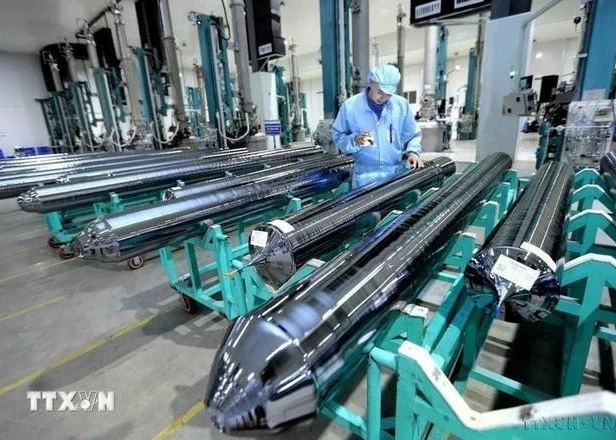 |
| Manufacturing materials for solar panel production at JA Solar Viet Nam Co., Ltd., a Hong Kong (China)-invested enterprise, at Quang Chau Industrial Park in Bac Giang province. (Photo: VNA) |
Blanchemaison noted that Viet Nam has integrated very successfully within the Association of Southeast Asian Nations (ASEAN), promoting practical and effective forms of cooperation among member states across a wide range of fields. With its impressive pace of economic growth, Viet Nam has emerged as an attractive destination for foreign investors, thanks to its stable environment, skilled workforce and extensive network of free trade agreements.
He said signals sent by the 14th National Congress will be closely watched by the investment community, particularly with regard to policy stability and the opening of new cooperation opportunities in advanced technologies. He observed that the entrepreneurial spirit of the Vietnamese people, together with the country’s economic achievements and its growing regional and global standing, has helped position the country as an increasingly important actor on the international stage. The prestige and role of Vietnamese diplomacy continue to be strengthened within major international organisations, especially bodies of the United Nations system.
From the perspective of a diplomat who has long been closely associated with Viet Nam, Blanchemaison said the international community expects the country to continue expanding cooperation agreements with all partners, based on a clear identification of priority areas and respective strengths. The nation has demonstrated its capacity to maintain political stability while gradually developing policies to ensure social welfare and expanding healthcare protection for its people. He also highlighted Viet Nam’s open and inclusive policy towards overseas Vietnamese as a notable strength.
At the same time, he pointed out that Viet Nam is among the countries most heavily affected by climate change, particularly the risks of saltwater intrusion and sea level rise in the Mekong Delta. These challenges, he stressed, require enhanced international cooperation, especially with countries sharing the same river basins, in order to seek sustainable solutions.
According to Blanchemaison, as a country that attracts the attention and engagement of most major powers, one of Viet Nam’s key challenges is to demonstrate its ability to maintain a balanced approach in relations with these partners.
 |
| Claude Blanchemaison, former French Ambassador to Viet Nam. (Photo: Published by VNA) |
Regarding Viet Nam-France relations, the former ambassador said bilateral cooperation should place stronger emphasis on future-oriented sectors. Expanding the intake of Vietnamese students into leading French universities and centres, combined with internship programmes prior to their return to serve the country, would generate long-term value, he suggested.
In addition to traditional areas of cooperation such as mathematics, medicine, law and economic management, Blanchemaison argued that collaboration should be broadened to new fields, particularly green transition and artificial intelligence.
He also noted that Viet Nam, with its rapid development in many high-tech sectors, could itself become an attractive destination for training and research for French students, thereby laying the foundations for a strong, two-way partnership.
Looking at broader prospects, he remarked that the two countries have only begun to tap their potential in security and defence cooperation, ranging from officer training and experience-sharing to areas such as reconnaissance, intelligence, including satellite-based capabilities, and defence systems.
At the European level, France continues to attach importance to promoting relations between Viet Nam and the European Union, which are already underpinned by free trade, investment protection and cooperation agreements. He added that in the future, the establishment of a political dialogue on security issues between Viet Nam and the bloc is also a direction worthy of consideration.
NDO


READER COMMENTS