
When technology goes hand in hand with sport
Technology is gradually transforming the face of modern sport, presenting Vietnamese sport with major opportunities, alongside real challenges, to fully harness scientific advances that can lift performance and help athletes reach new heights.
 |
| The GPS gilet collects data for analysing individual performance. (Photo: VNA) |
A surging wave
Over the past decade, technology has profoundly transformed global sport - from training and competition to the fan experience. Real-time data systems, artificial intelligence (AI), wearables and video analysis are helping athletes improve performance, reduce injury risk, and optimise tactics to deliver the best possible results.
At Paris 2024, China’s 3x3 basketball team caused a stir when it defeated title favourite Serbia 21–15. About an hour later, a detailed tactical breakdown was released highlighting the increasingly visible role of AI in supporting tactical decision-making. At EURO 2024, VAR technology was upgraded with AI, cutting incident processing time to under 30 seconds, compared with around 70 seconds at the 2022 World Cup. In endurance sports such as marathons and triathlon, AI combined with IMU sensor systems can detect running gait asymmetry and signs of overload with 68–69% accuracy, helping to prevent injuries and optimise performance.
Amid this technology surge, Viet Nam has been gradually catching up and moving with the modern trend. In recent years, images of Vietnamese athletes training and competing with technological support have become increasingly familiar. In July 2025, the Viet Nam Sports Administration partnered with DreaMax Technology Company to officially apply AI in sports training, piloting it in shooting, archery, taekwondo, and boxing — marking a turning point in the digital transformation of Vietnamese sport. AI processes athlete data throughout training and competition, compares it with international levels, and helps coaches design evidence-based training plans, time peak form, and adjust tactics more effectively.
Hoang Quoc Vinh, Head of the High-Performance Sports Division 1 under the Viet Nam Sports Administration, said AI is particularly useful for mind sports such as chess, and for team sports that require statistical tracking of attacking and defensive indicators, tactical coordination, and movement counts, providing coaches with timely, accurate figures. In that sense, he noted, AI can function like a highly effective assistant coach during training and competition.
At SEA Games 33, Viet Nam’s delegation brought 19 doctors and medical specialists, applying techniques and health data throughout the competition period, combined with AI to monitor athletes’ condition, support fitness maintenance, and analyse health - an indirect but highly important application of technology in sustaining performance under heavy match loads.
At the same Games, moments such as Van Thuan or Thanh Nhan taking off their shirts in celebration after decisive goals - helping U22 Viet Nam clinch the title - quickly drew attention on social media. Beyond the on-pitch emotion, many were curious about the distinctive sleeveless top worn underneath. This was not a fashion accessory, it was a GPS performance-tracking vest (GPS Gilet/GPS Vest) - part of an Electronic Performance and Tracking Systems setup. The main sensor is positioned between the shoulder blades, collecting data on position, distance covered, acceleration, direction, and movement posture via GPS/GNSS. The data is transmitted to analysis software, enabling coaching staff to assess fitness, control overload, and prevent injuries. In Viet Nam, this technology has been in use since the time of coach Park Hang-seo and is now common across many clubs.
For Vietnamese sport, it is clear that technology adoption carries a special significance in narrowing the gap with regional and global rivals. Instead of investing for decades in infrastructure and experience, Viet Nam can “leapfrog” by applying advanced technologies already available.
A roadmap for the future
However, no path is ever entirely smooth. Vietnamese sport still faces many challenges and remains behind international standards. For global sporting powers, and even within Southeast Asia, such as Singapore and Thailand, integrating science and technology into training and competition has become an indispensable foundation.
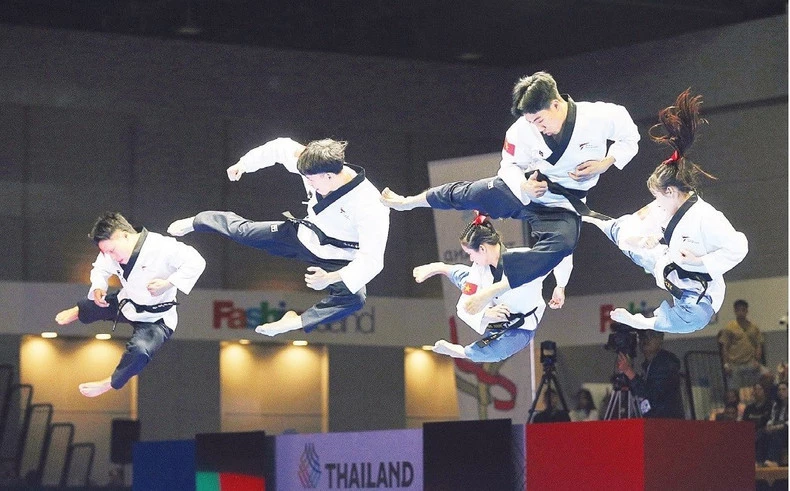 |
| Taekwondo is one of the key sports where AI has been applied in training. Photo: SONG NGU |
According to a survey by the Viet Nam Sports Administration in late 2024, among more than 20 key training centres, only the National Sports Training Centre in Ha Noi had a basic data-analysis room; the rest lacked systems for fitness monitoring, performance evaluation and AI application. Meanwhile, in Japan, all Olympic athletes are monitored daily with sensors and trained under personalised programmes built on scientific data.
In practice, funding remains the biggest bottleneck. The GPS vest, for example, is part of an expensive technology ecosystem: suppliers typically do not sell it as a standalone product but deliver a full solution under annual contracts. Internationally, costs for professional teams range from around 50,000 to 100,000 USD per year, depending on squad size and the depth of analysis. Some standalone versions are advertised at 150–200 USD but require additional software fees. As a result, not every unit can afford such costs; without adequate investment, some sports strengths show signs of stagnation.
In addition, funding for sports science remains limited. Many research projects cannot proceed due to a lack of modern equipment. International cooperation and partnerships with reputable universities have not received sufficient attention, leading to gaps in advanced knowledge and experience. At local level, the difficulties are even more apparent as many coaches have not kept pace with the trend and constraints in funding and facilities make technology adoption in training far more challenging.
Viet Nam has taken concrete steps such as deploying VAR in the V. League, with training centres proactively digitising coaching processes and using AI software to test, evaluate, and manage nutrition. In addition, some Vietnamese technology start-ups like StrengthAI have begun developing motion-analysis applications to correct technique and reduce injury risk.
Nguyen Danh Hoang Viet, Director General of the Viet Nam Sports Administration, noted that modern AI systems still depend on a capable team to run them, including not just coaches and athletes but also data experts, engineers, and sports physicians. Viet Nam is currently severely short of professionals who can connect sport with technology.
For technology to truly become a driver that lifts Vietnamese sport, a coordinated roadmap with firm, practical steps are needed. Professor Dr Nguyen Dai Duong, former Rector of Bac Ninh University of Physical Education and Sport, said the sector should accelerate the development of an interconnected data system linking national training centres, training and research institutions, and local athlete development networks. At the same time, it should build high-tech training labs; apply software to analyse technique, fitness, and psychology; and adopt tiered investment aligned to different levels to improve athlete development efficiency.
International cooperation and technology transfer are also effective directions with initial efforts such as collaboration with the French Embassy or Nantes University to access advanced data-analysis solutions. Alongside this, a clearer legal corridor is needed to attract private investment into sports technology, an area with strong potential but still largely untapped.
Looking further ahead, sport should be viewed as an economic sector where technology helps raise performance, create jobs, promote the country’s image, and support sustainable growth.
Today, sport is no longer only a contest of strength and talent, but also a race of data collection, analysis, and innovation. The journey remains challenging, but to turn potential into real strength, technology is an indispensable key that Vietnamese sport must actively grasp to write the next chapter of future breakthroughs.
NDO


READER COMMENTS