Assessing officials through work results
Assessing officials in a practical manner, with work products and performance results serving as key measures, is being implemented across Tuyen Quang Province. The approach is expected to help overcome formalistic and equalized assessments, while encouraging officials to think boldly, act decisively and take responsibility for their work.
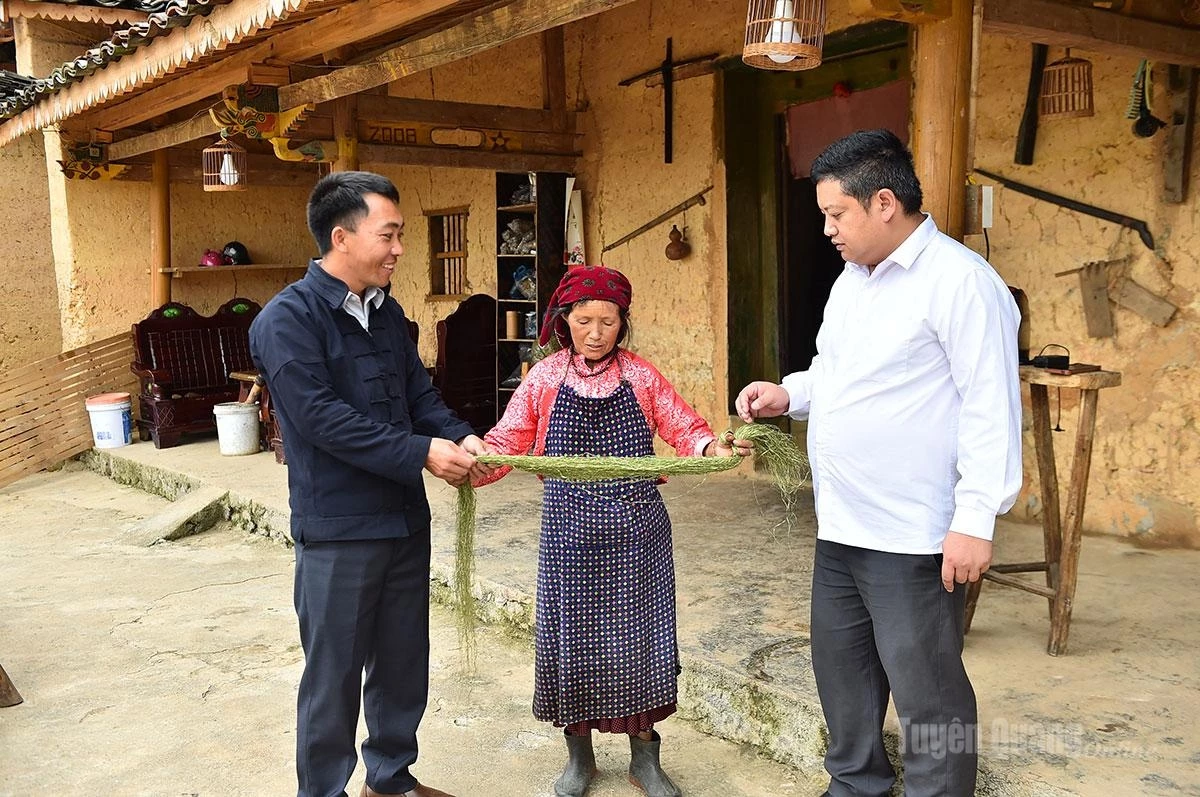 |
| Officials of Lung Cu Commune learn about a local flax weaving model. |
Under Official Dispatch No. 1619-CV/TU dated September 16, 2026, issued by the Provincial Party Committee’s Standing Board on the assessment and classification of officials for the third quarter of 2026, Party committees at all levels are required to review and improve their working regulations, clearly assign responsibilities, establish lists of tasks and work products, and individualize targets and criteria based on the performance of assigned functions and duties. Assessments must combine qualitative and quantitative measures, ensuring clarity in tasks, products, results and deadlines.
In Yen Phu Commune, officials, civil servants and public employees are required to maintain daily work-product logs covering different groups of tasks, including duties related to their positions, unexpected assignments, common tasks of their agencies and units, and difficult or complicated issues requiring solutions. Work products with supporting evidence serve as a basis for assessment. The commune also assigns key and breakthrough tasks on a quarterly basis, linking them to criteria on quantity, quality, progress and leadership and management capacity.
In Hong Son Commune, the results of breakthrough tasks are used as one of the criteria for assessing officials, from commune-level officials to Party cell secretaries in villages. The development of a high-quality ST25 rice production model is one example. From an initial area of 10 hectares, the model expanded to 31 hectares during the summer-autumn crop, generating higher economic efficiency than conventional rice varieties.
In public administration reform, the results of serving residents have also become concrete indicators of work performance. After one year of operating the two-tier local government model, 99.21% of administrative procedure dossiers were processed on time or ahead of schedule, while the satisfaction rate among residents and businesses reached 97.27%.
However, assessing officials through work products does not mean applying the same criteria to every locality. In communes with large areas, dispersed populations and difficult socio-economic conditions, assessment criteria need to be flexible and practical, while taking into account the quality, progress, effectiveness and conditions under which tasks are carried out.
Regular, results-based assessments help identify shortcomings at an early stage, recognize capable and responsible officials, and clarify the responsibilities of heads of agencies and units. This, in turn, contributes to improving the effectiveness of leadership, management and public service delivery.
Thanh Phuc


READER COMMENTS