
Preserving the green forests
Tuyen Quang is considered the “green gold” of the Northeast region, home to extensive natural forests, nature reserves and national parks with rich biodiversity. In recent years, forest planting and protection have been implemented un a coordinated manner with the participation of local authorities, forest rangers and local communities, contributing to the sustainable preservation of the province’s forest cover.
Responding to the annual tree-planting campaign “Tet Tree Planting Festival in gratitude to President Ho Chi Minh”, the province launched the 2026 spring campaign in Tan Trao Commune. The movement attracted more than 27,000 participants across 429 launch sites throughout the province, planting 171,000 new trees, equivalent to about 130 hectares of forest. The activity not only helps green barren hills and unused land but also raises public awareness of environmental protection and promotes sustainable forestry development.
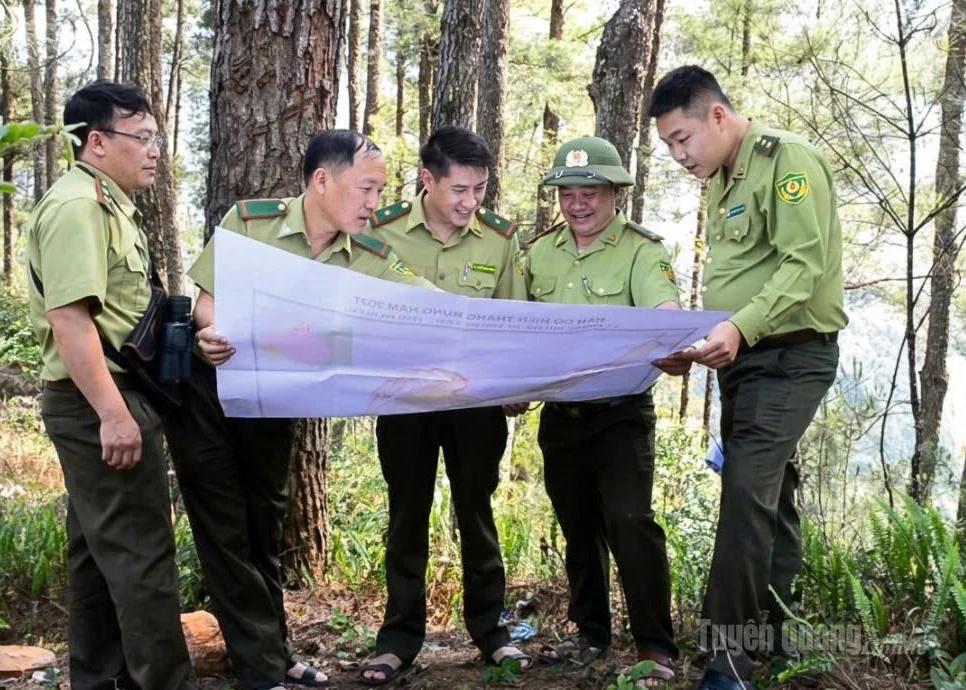 |
| Officers of Forest Ranger Unit XVI patrol the forest, compare forest maps, monitor the current status and promptly handle violations at the grassroots level. |
Tuyen Quang currently has a forest coverage rate of over 62 percent, ranking third nationwide. In 2026, the province aims to plant 13,700 hectares of new forests, a 10 percent increase compared with 2025, while also improving the quality of planted forests and expanding effective forest management and protection models.
Alongside these efforts, several tree-planting programs have been implemented, including the “Green Border Belt” initiative carried out by border guard forces in coordination with local authorities. The program helps plant trees along border areas, reduce soil erosion and protect the ecological environment.
However, some limitations remain in forest planting activities, such as a focus on quantity rather than quality, low survival rates of newly planted trees in some areas, and a planting structure that still prioritizes fast-growing species with short-term economic value. Experts suggest that increasing the proportion of native tree species is necessary to ensure ecological balance and biodiversity conservation.
In addition to management measures, many local communities continue to maintain traditional forest-protection customs. Rituals such as forest worship ceremonies practiced by ethnic groups, including the Nung, Pu Peo, Phu La and Lo Lo are considered unwritten rules that help strengthen community awareness in protecting sacred forests, headwater forests and natural ecosystems.
The province currently has more than 900,000 hectares of forest, including nearly 621,000 hectares of natural forest. To safeguard this area, forest rangers regularly conduct patrols, remain stationed in remote locations and closely monitor key areas. The coordination between authorities, functional forces and local people has become a key foundation for preserving the green forests and promoting sustainable livelihoods for communities in the region.
Hong Ha


READER COMMENTS