
From historic landmark to prosperity: Kim Binh’s transformation
Seventy-five years ago, Bo Cung Hamlet in Kim Binh Commune, Tuyen Quang Province was honored to be selected as the venue for the 2nd National Congress of the Communist Party of Vietnam - the first Party Congress ever held inside the country. This landmark historical event has since become a source of pride for the ethnic communities of Tuyen Quang in general and Kim Binh in particular, serving as a strong driving force for local authorities and residents to build an increasingly prosperous homeland.
 |
| A delegation of former leaders of Tuyen Quang Province pays tribute and offers incense at the Kim Binh Special National Historical Site. |
More than seven decades on, Kim Binh has undergone remarkable changes. Alongside the solemn and time-honored atmosphere of the Kim Binh Special National Historical Site, the commune continues to preserve the distinctive cultural identity of the Tay ethnic group, reflected in traditional stilt houses with bright red-tiled roofs, the gentle melodies of Then singing accompanied by the tinh lute, and the graceful image of Tay women in traditional attire - all of which leave a lasting impression on visitors.
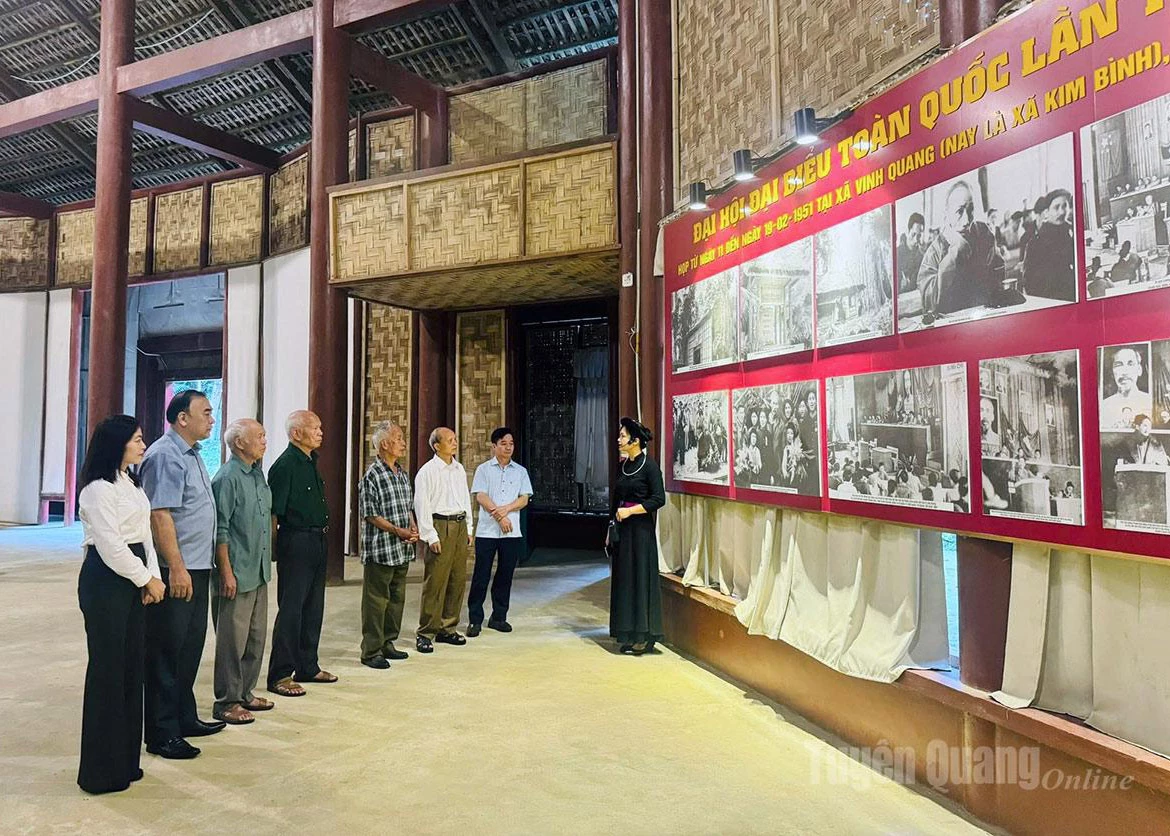
Nestled beneath the lush forest canopy on Na Loang Hill, Bo Cung Hamlet, home to the Kim Binh Special National Historical Site where the 2nd Party Congress was held, has become a “red address” for revolutionary education, attracting hundreds of thousands of visitors each year to visit, study, and learn about history. The site has been faithfully restored, featuring the Congress hall, the memorial to fallen heroes, President Ho Chi Minh’s living and working hut, and the stele house. From February 11 to 19, 1951, the 2nd National Party Congress took place here with the participation of 158 official delegates and 53 alternate delegates, representing more than 760,000 Party members nationwide.
Alongside the preservation of historical values, Kim Binh has focused on economic development and improving local livelihoods. To date, the commune’s poverty rate has fallen to below 10 percent, while criteria for new-style rural development continue to be maintained and enhanced. The commune currently has more than 30 high-income economic models, each generating annual revenues of over VND 200 million.
In Bo Cung Hamlet, many Tay households have renovated traditional stilt houses to meet homestay standards, combining tourism development with cultural preservation. Traditional weaving has evolved into the production of bamboo drying racks for agricultural products, providing stable employment and additional income for local people. At the same time, new production models such as high-yield gac fruit cultivation and greenhouse-grown melons using high-tech agricultural methods have delivered clear economic benefits, contributing to the restructuring of local crops.
As another spring arrives in the revolutionary homeland of Kim Binh, the rural landscape continues to flourish, with improved infrastructure and rising living standards. With determination from the entire political system and development solutions suited to local conditions, Kim Binh is steadily affirming its transformation, living up to the proud revolutionary traditions of this historic land.
Le Duy


READER COMMENTS