
Can Ty Commune strives to build new rural areas
As a border commune in one of the province’s most disadvantaged areas, Can Ty has undergone a gradual transformation through the implementation of the National Target Program on New Rural Development. Starting with housing improvements and residential area upgrades linked to economic development, the commune’s achievements reflect a strong public consensus and the active involvement of the entire political system.
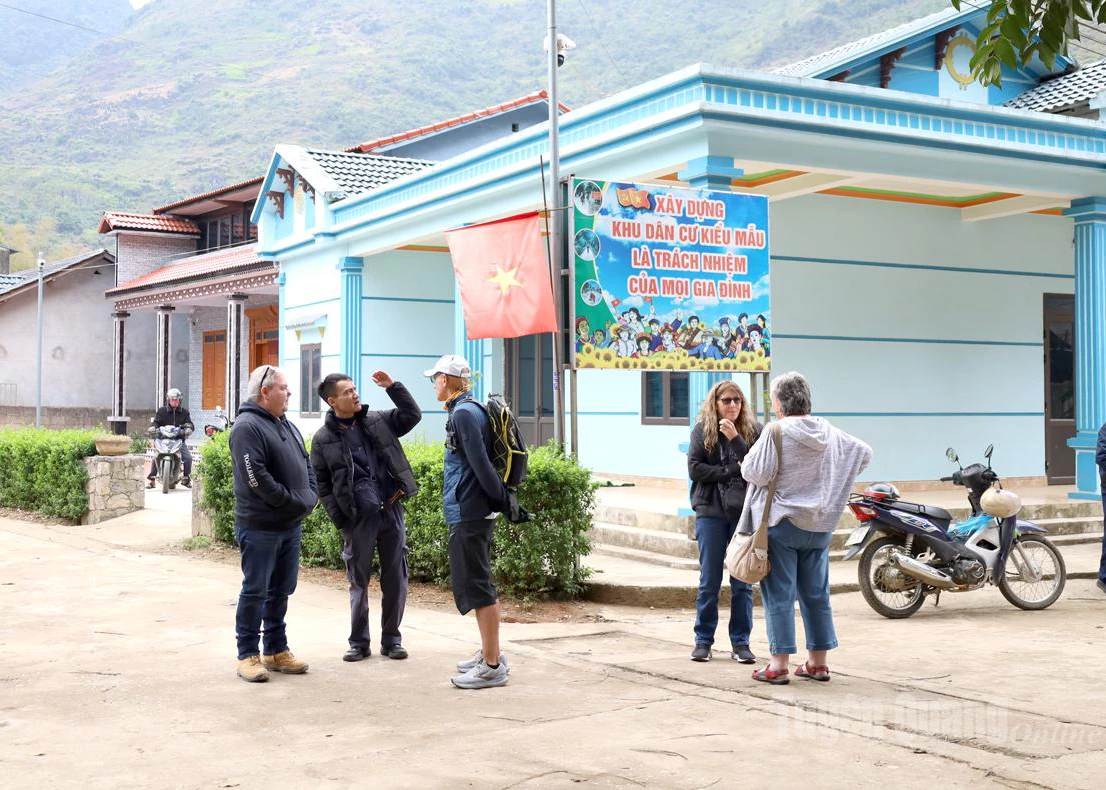 |
| International tourists visit and experience the model residential area of Can Ty commune, a highlight in the development of community-based tourism. |
Formed through the merger of Can Ty and Bat Dai Son communes, Can Ty covers more than 85 square kilometers and shares a 5.7-kilometer border. The commune comprises 17 hamlets with 1,886 households and 9,824 residents, of whom more than 64 percent are poor households. Given these socio-economic challenges, local authorities have identified new rural development as a key task, closely linked to improving people’s living standards.
Implementation has focused on criteria aligned with local conditions, prioritizing investment in rural transport infrastructure, landscape improvement, the construction of cultural houses, and the development of model residential areas. These efforts have gradually raised public awareness of environmental hygiene, livestock facility improvement, and the adoption of civilized lifestyles.
Thanks to concentrated investment in infrastructure, all hamlets now have access to the national power grid, while 67 percent of hamlets have roads meeting standards. Many inter-hamlet roads have been concreted, facilitating travel and agricultural trade, particularly during the rainy season. In parallel, national target programs and social welfare policies have been implemented in a timely and coordinated manner, contributing to tangible improvements in living conditions. In 2025, the commune reduced 67 poor and near-poor households; the multidimensional poverty rate fell by 5 percent compared to the previous year, and 100 percent of residents were covered by health insurance.
Alongside infrastructure development, Can Ty has promoted livelihood diversification and income generation. In 2025, the commune piloted a four-hectare custard apple cultivation model, which has shown initial positive results. In addition, six products of the Can Ty Linen Weaving Cooperative have been certified as three- and four-star OCOP products, helping enhance value and market competitiveness.
Housing stabilization has been identified as a key foundation for new rural development. Through the National Target Program on Sustainable Poverty Reduction, 29 households received support for housing construction and repair in 2025, contributing to the formation of model residential areas. Improved living spaces and well-maintained villages have also become attractions for visitors, supporting the development of community-based tourism.
With newly built houses, upgraded roads, and strong community engagement, Can Ty is steadily progressing toward meeting new rural criteria and improving livelihoods in this remote border area.
Nhu Quynh


READER COMMENTS