
Bringing light to remote villages: Eliminating power black spots in Tuyen Quang
With rugged mountainous terrain, scattered populations and many villages located far from commune centers, bringing the national power grid to remote and disadvantaged areas of Tuyen Quang Province has long been considered a major challenge. However, through strong determination, flexible approaches and the concerted efforts of Party committees, local authorities and the power sector, many electricity “black spots” have gradually been eliminated, bringing light to distant villages.
Na Bo is a highland hamlet of Lien Hiep Commune, where 100 percent of residents are Dao people. Living conditions remain difficult, transportation is challenging, and rugged terrain has posed significant obstacles to investment in essential infrastructure. Although the access road to the hamlet has been upgraded in recent years, household electricity has long been the greatest aspiration of local people.
 |
| Construction workers at the Na Bo Hamlet power supply project actively install power lines to complete the electricity project for local people. |
In the small house of Trieu Mui Mui, the flickering fire by the stove keeps the family warm during cold winter days. She could not hide her joy upon hearing that the hamlet would soon be connected to the national grid. “We are very happy that electricity is coming. Many households have already bought rice cookers, electric kettles and televisions, just waiting for the day power is available. With electricity, cooking and daily life will be much more convenient, especially for our children’s studies,” she said. According to Phan Chieng Kinh, head of Na Bo Hamlet, for many years the biggest wish of residents has been to have electricity for daily life and production. “Once electricity arrives, the rural landscape will surely change, especially during Lunar New Year celebrations, making the atmosphere warmer and more joyful,” he said.
In late 2025 and early 2026, on the mountain slopes surrounding Na Bo hamlet, rows of power poles were erected, with transmission lines stretching along steep ridges, crossing high slopes and fields of white-blossoming cogon grass. Despite cold weather and extremely difficult terrain, power workers worked tirelessly, racing against time to bring electricity to the hamlet before the Lunar New Year of 2026. Nguyen Van Nga, head of the construction team for the Na Bo power supply project, said that more than 90 percent of the work had been completed, with crews focusing all manpower and equipment on finishing the remaining items for handover and energization.
Dang Van Thang, head of the Bac Quang area power management team, said that Na Bo Hamlet, along with several others, lies in areas with extremely complex terrain and difficult access, posing major challenges to grid expansion. In the short term, temporary power supply solutions using generators have been deployed to meet essential needs, while efforts continue to accelerate grid projects to ensure progress.
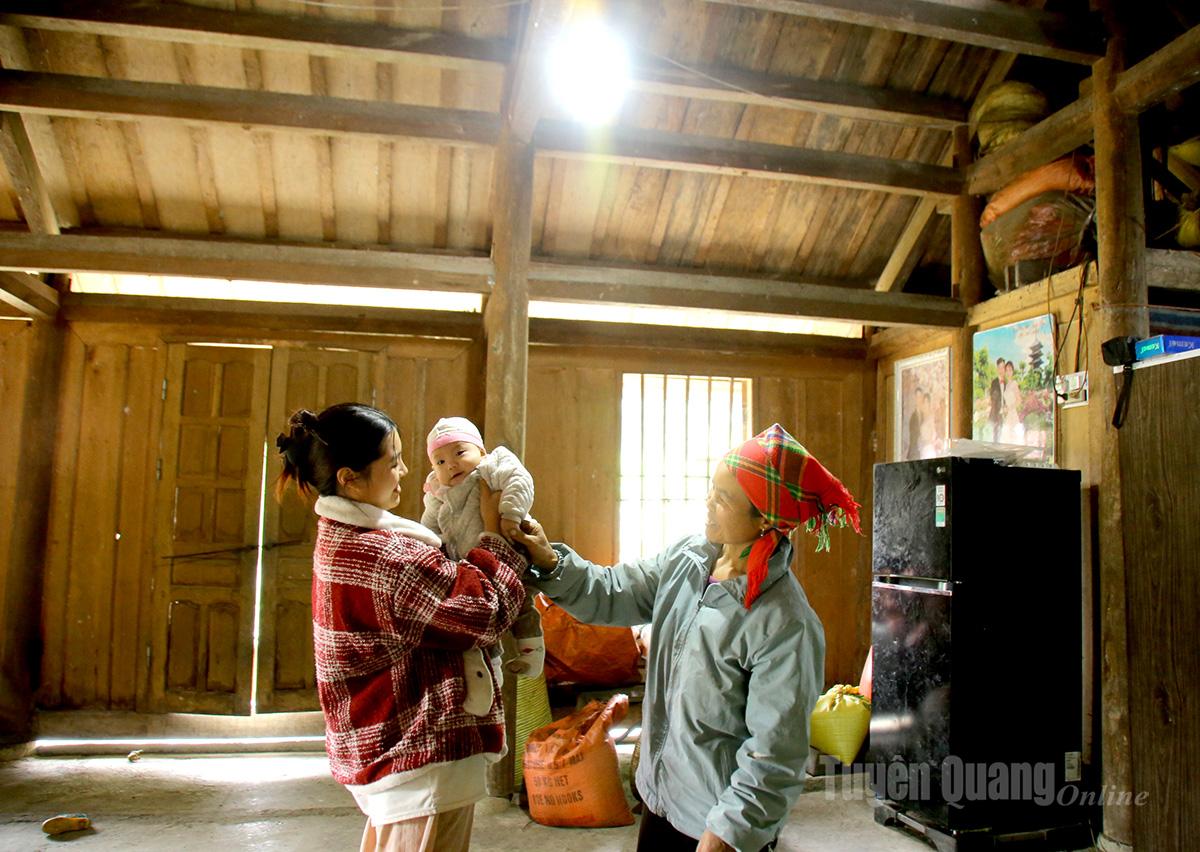 |
| People of Na Bo Hamlet, Lien Hiep Commune, are delighted ahead of the arrival of the national power grid. |
According to Tuyen Quang Power Company, the province currently has 24 remaining electricity and telecommunications “black spots.” As of December 15, 2025, seven hamlets - Ha To So, Ha Pong Cay, Tung Pang, Khau Rom, Tat Ke, Sung Ta and Sung Cho - had been connected to the national grid. In areas where grid extension is not yet feasible, the power sector has flexibly implemented on-site power supply solutions. Specifically, in Na Bo Hamlet (Lien Hiep Commune) and Bo Duot Hamlet (Thuong Son Commune), three 12.5 kVA generators combined with lithium battery storage systems have been installed to ensure essential electricity for daily life and communications while awaiting completion of grid projects.
Eliminating electricity “black spots” not only brings economic benefits but also carries profound social significance. Access to electricity enables people in remote and mountainous areas to better access information, healthcare and education, while creating conditions for the development of production and services and gradually improving living standards. It also reflects the care and commitment of the Party, the State and the power sector toward people in remote and disadvantaged areas, contributing to the goal of sustainable development and ensuring that no one is left behind on the country’s path forward.
Van Long


READER COMMENTS