
Industrial cluster development in Tuyen Quang: Removing bottlenecks to boost investment and exports
Tuyen Quang is accelerating the development of industrial clusters (ICs) to serve as a new growth driver, attract investment, and promote import–export activities, gradually affirming their role as a key lever in the province’s industrial development. Under the 2021–2030 master plan, the province aims to develop 48 ICs with a total planned area of around 2,450 hectares, while removing less efficient clusters to concentrate resources on more advantageous locations.
Currently, the province has 17 established ICs covering approximately 810 hectares, attracting 45 projects with total registered capital of more than VND 8,377 billion. Of these, 34 projects have already become operational, creating jobs for nearly 10,200 workers. Several clusters have achieved high occupancy rates, including Phuc Ung (nearly 97%), Thang Quan (nearly 88%), and Minh Son 2 (100%). Many enterprises within these clusters are participating in export-oriented production chains, helping local industrial products reach international markets.
Notably, Greenhome Flooring Co., Ltd., operating in Thang Quan Industrial Cluster, is maintaining stable production of industrial flooring products exported to the United States, Canada, and the United Kingdom, with an output of 8–10 containers per month. Meanwhile, HITARP Vietnam in Phuc Ung 1 Industrial Cluster is producing packaging yarn for export, contributing to the expansion of the province’s industrial export capacity.
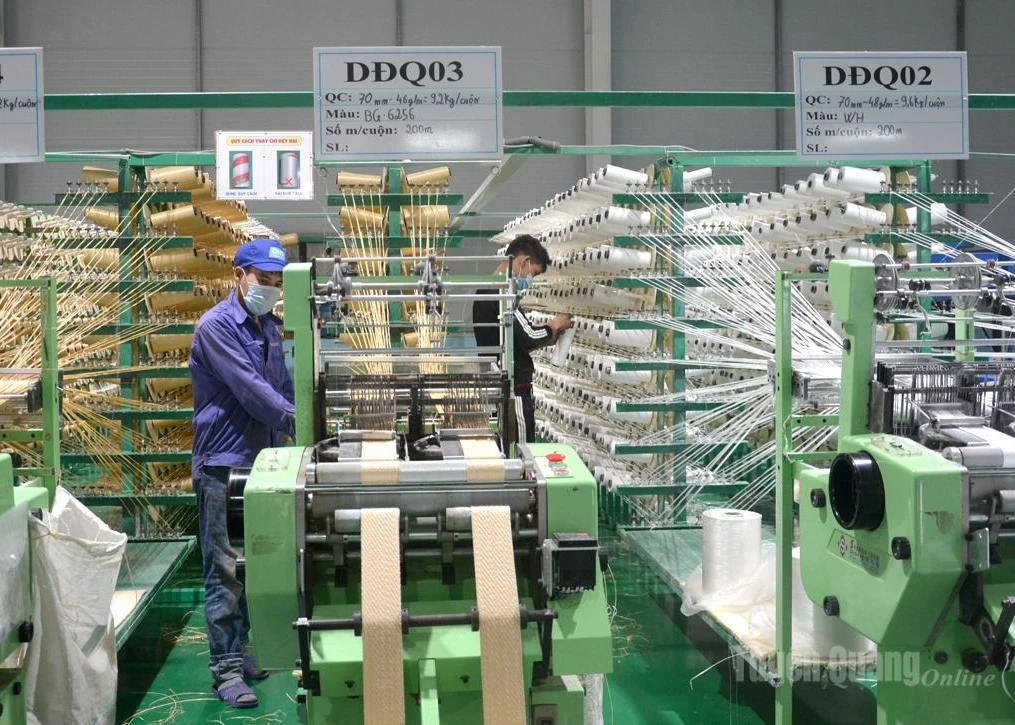 |
| Export packaging yarn production at HITARP Vietnam Company, Phuc Ung 1 Industrial Cluster, Son Duong Commune. |
However, the average occupancy rate of industrial clusters remains at only around 43%, reflecting significant development potential but also highlighting bottlenecks in infrastructure, land clearance, and investment attraction. Several clusters still lack synchronized technical infrastructure, including wastewater treatment systems, internal transport networks, and logistics connectivity, limiting their attractiveness to secondary investors.
The main constraints are identified in implementation rather than planning, with land clearance, shortages of construction materials, and weak infrastructure connectivity among the most pressing issues. Large projects such as Ninh Lai – Thien Ke, An Hoa – Long Binh An, and Trung Mon Industrial Clusters continue to face delays due to procedural and site clearance challenges.
In the coming period, Tuyen Quang will focus on removing institutional and procedural bottlenecks related to investment procedures, land management, environment, and infrastructure development, with a clear assignment of responsibilities and deadlines. The province will also improve the investment climate, complete industrial cluster infrastructure, enhance logistics connectivity, and support enterprises in expanding production for export.
In the long term, the province aims to develop industrial clusters in a synchronized and modern direction, strengthen competitiveness, and attract secondary investment, thereby boosting industrial growth and contributing more significantly to import–export performance and overall economic development.
Trang Tam

READER COMMENTS