Transport infrastructure drives Tuyen Quang’s growth ambitions
Amid the festive atmosphere of the Lunar New Year 2026, and following the provincial merger on July 1, 2025, Tuyen Quang has entered a new phase of development with expanded scale and amplified potential. The Provincial Party Committee has identified transport infrastructure development as one of three strategic breakthroughs, viewing it as the “key” to unlocking rapid and sustainable growth.
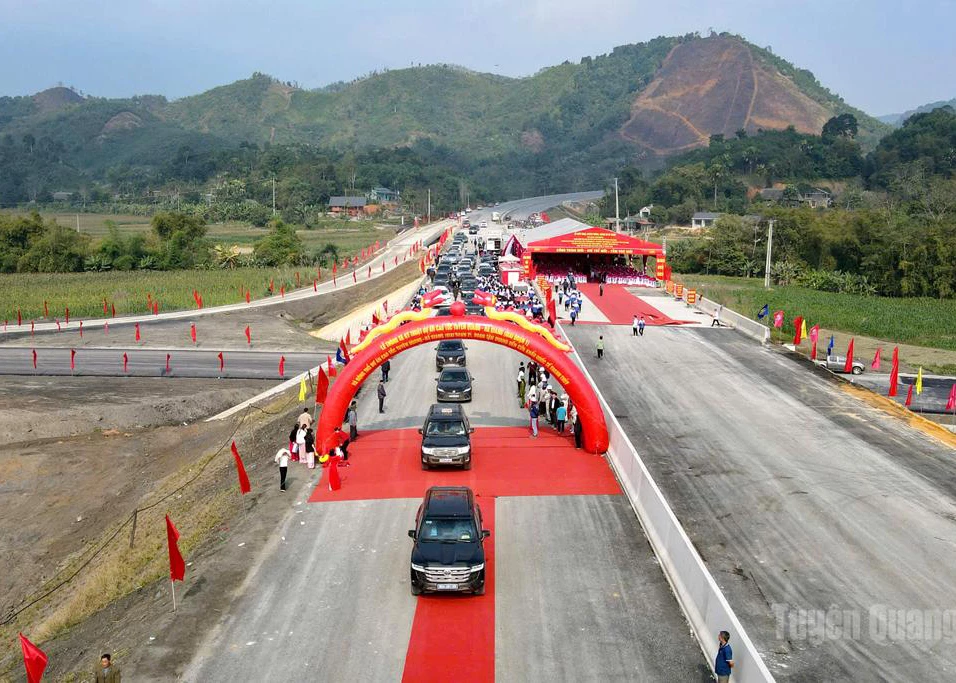 |
| The first vehicles travel along the newly opened Tuyen Quang–Ha Giang Expressway. |
In 2025, the province recorded an industrial production value of over VND 33 trillion, up more than 20 percent year-on-year. Import-export turnover surpassed USD 1 billion, nearly doubling compared to the previous year, while tourist arrivals reached nearly 4 million, generating revenues exceeding VND 10 trillion. These figures reflect rising demand for transportation, logistics and market connectivity, making modern and synchronized transport infrastructure an essential prerequisite.
Following the merger, the Provincial People’s Committee revised the master plan, prioritizing integrated transport infrastructure capable of linking administrative centers with mountainous and border areas. Expressways have been designated as the backbone of the province’s connectivity strategy.
The 40-km Tuyen Quang–Phu Tho Expressway, operational since late 2023, has significantly shortened travel time from Hanoi to the provincial center, eased congestion on National Highway 2 and improved access to industrial zones and clusters, thereby enhancing investment attraction.
Phase 1 of the Tuyen Quang–Ha Giang Expressway, spanning 104.5 km, was partially opened to technical traffic on December 19, 2025, and is expected to become fully operational in 2026. The route will strengthen links to northern areas of the province, boosting agriculture, services and border trade. Phase 2, extending to Thanh Thuy International Border Gate, is scheduled to commence this year, forming a strategic corridor from Hanoi to the border gate and facilitating cross-border trade and tourism.
Experts note that the province’s vast and mountainous terrain entails high construction and maintenance costs, requiring diversified funding sources and strengthened oversight to ensure project efficiency.
Under a thematic resolution for the 2026–2030 period, the province aims to complete its expressway network while upgrading national and provincial roads to enhance horizontal connectivity among regions. Once fully integrated, the transport system is expected to serve as a powerful driver of socio-economic growth, improve living standards and position Tuyen Quang as a dynamic development hub in the northern mountainous region.
Duy Tuan


READER COMMENTS