Highland medicinal plants go global
On the highland slopes of Vi Xuyen Commune, a new pathway for indigenous medicinal plants is gradually taking shape thanks to the efforts of Nguyen Thi Hong Lieu. Born in 1982 and belonging to the Tay ethnic group, she received formal training in agriculture and biotechnology before choosing to return to her hometown to develop the local economy based on its inherent potential.
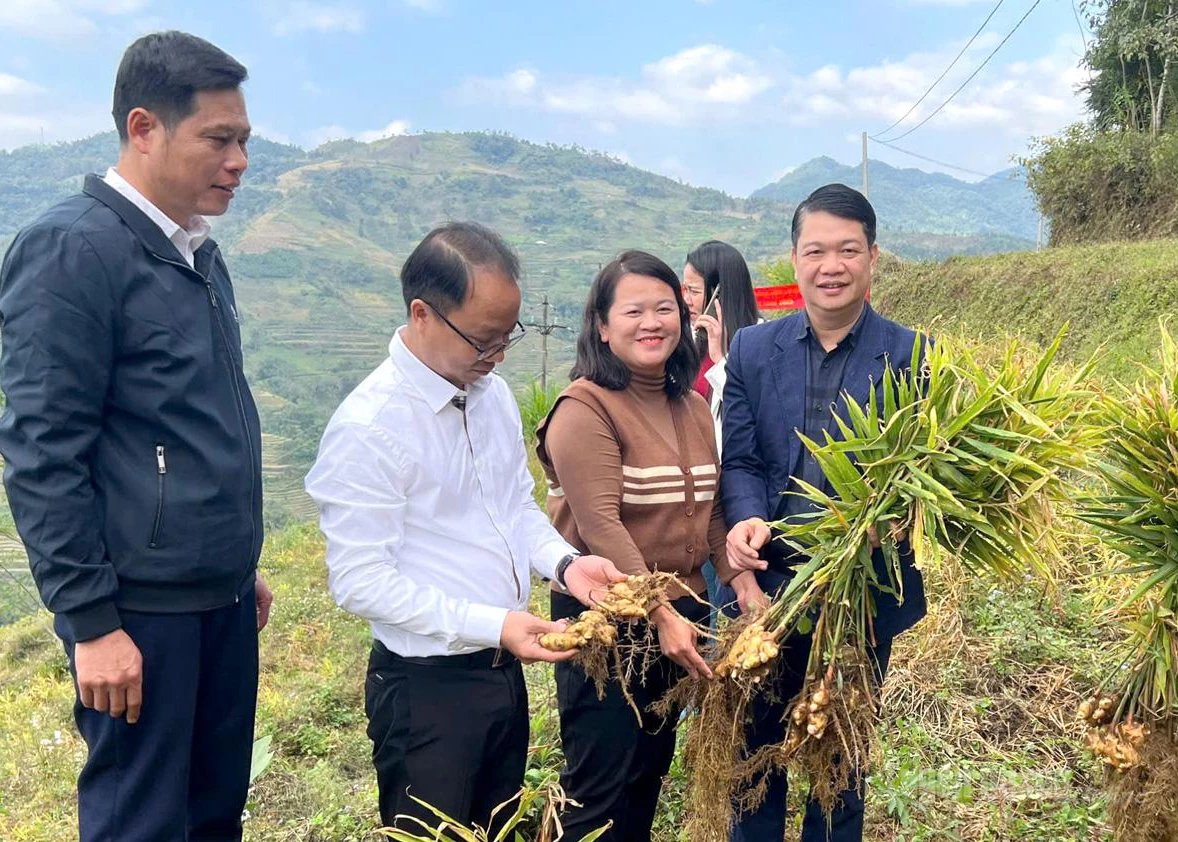 |
| Leaders of the Department of Agriculture and Environment visit the ginger raw material area of Son Y Medicinal Cooperative. |
In 2019, Liu and seven members founded Son Y Medicinal Cooperative, initially focusing on pennywort cultivation. Instead of small-scale, fragmented farming, the cooperative tested multiple varieties, selected suitable strains, and established standardized cultivation processes. As a result, raw material areas expanded across Vi Xuyen and Phu Linh communes, generating stable incomes of VND 250–300 million per hectare for local farmers.
Beyond raw production, the cooperative invested in deep processing, producing items such as pennywort tea and powder, gradually accessing international markets, including Japan. Meeting stringent requirements on quality, traceability, and packaging has helped enhance the cooperative’s production capacity and build a solid foundation for sustainable development.
Building on early success, the cooperative expanded into ginger and turmeric cultivation in Bac Me and Đuong Hong communes. To date, the linked ginger-growing area has reached 120 hectares, with an average yield of 35–40 tons per hectare. The production–consumption linkage model ensures stable output, helping farmers increase their incomes, with some households earning profits exceeding VND 90 million per hectare annually.
Notably, the cooperative has partnered with Vinasamex (Vietnam Cinnamon and Star Anise Production and Export Joint Stock Company), gradually integrating local medicinal plants into export value chains. After three years of refining cultivation areas and production processes, the cooperative has met international standards such as Organic and Fairtrade, qualifying to supply export-grade raw materials.
Currently, the cooperative has mastered organic cultivation processes for key crops, including ginger, turmeric, onion, garlic, and chili, while also expanding into other medicinal plants such as Ardisia silvestris and Codonopsis. In the coming period, it aims to further expand internationally certified raw material areas and penetrate more demanding markets.
Lieu’s journey not only enhances the value of local medicinal plants but also affirms the role of collective economic models in advancing green and sustainable agriculture.
Quynh Chau


READER COMMENTS