Tuyen Quang advances toward green and smart industrial development
Industry is identified as a key economic pillar for Tuyen Quang Province’s fast and sustainable development. Accordingly, developing green and smart industry is both a guiding principle and a strategic objective for the province in the 2025–2030 period, in line with Viet Nam’s commitment at COP26 to achieve net-zero emissions by 2050.
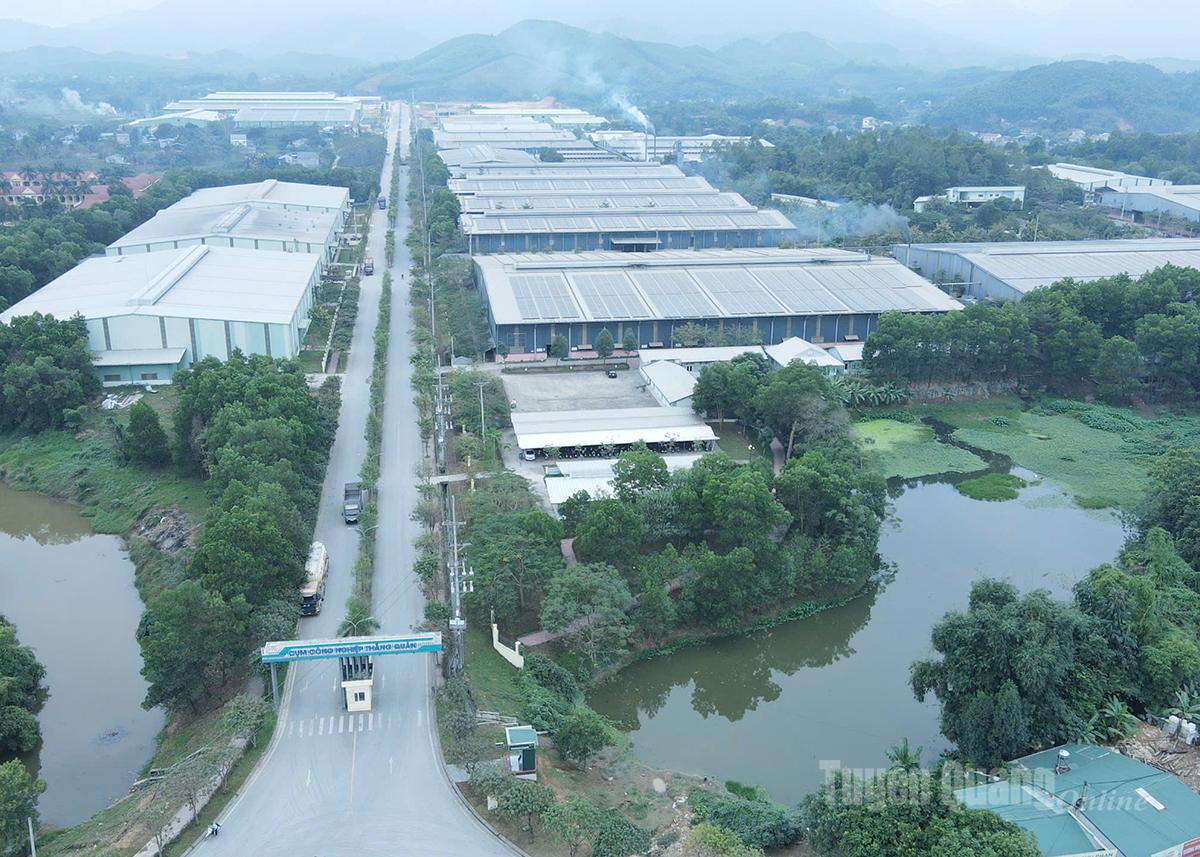 |
| Thang Quan Industrial Cluster, where many enterprises are applying technology in production. |
Green and smart industrial development is seen as an inevitable path to reducing carbon emissions, saving energy and water, expanding the use of renewable energy, and minimizing environmental pollution. At the same time, it helps optimize production processes, cut operating costs, improve productivity and product quality, meet strict export market standards, and enhance global competitiveness.
An Hoa Paper Joint Stock Company in Binh Ca Commune is considered a model for the transition from conventional industrial production to green and smart manufacturing. As part of its green transformation, the company has utilized factory rooftops and water surfaces to install rooftop and floating solar power systems with a capacity of nearly 10 MWh, meeting around 50% of its electricity demand. Along with product diversification and process optimization, these measures have helped reduce electricity consumption for production by about 25%.
Moreover, by improving production processes and applying automation in multiple stages - such as automatic control systems and continuous cooking technology - the company has reduced raw material consumption and optimized management. Its direct workforce has been streamlined from 1,200 to 800 employees, a reduction of 30%, contributing to lower costs and higher productivity. These changes demonstrate the effectiveness of integrating digital transformation with green development.
In recent years, Tuyen Quang’s industrial sector has made strong progress, with industrial production value growing at an average rate of 11.5% per year during the 2020-2025 period. The sector contributes more than 38% of the province’s GRDP and provides jobs for thousands of workers. Industrial parks and clusters have attracted dozens of investment projects with total registered capital exceeding VND 6 trillion, and the occupancy rate has reached nearly 50%.
In pursuit of clean energy development and carbon emission reduction, the province currently operates 51 hydropower plants and one biomass power plant, with a combined capacity of over 1,300 MW and an average annual output of 4.8 billion kWh. These facilities contribute approximately VND 4.5 trillion in production value and about VND 1 trillion to the state budget each year.
The Industrial Promotion Program for 2021-2025 has supported more than 60 projects, helping numerous rural industrial establishments upgrade technology, invest in energy-saving equipment, and adopt cleaner production methods. Meanwhile, the local industry and trade sector has gradually “smartened” production and commercial activities by building industrial-economic databases, integrating VR360 images of industrial parks and clusters, and deploying various smart sales and customer service solutions to support data management, product traceability, and market expansion through e-commerce.
Looking ahead to 2025-2030, Tuyen Quang aims to focus on green, circular industrial growth linked with digital transformation and high technology. The province plans to develop industrial clusters and renewable energy projects, attract high-tech investment, promote supporting industries, and pilot a smart industrial cluster managed through digital platforms for infrastructure, energy, and logistics. These efforts are expected to lay the foundation for a smart industrial ecosystem in the northern mountainous region, positioning Tuyen Quang as a dynamic, environmentally friendly hub for green industry.
Duy Tuan


READER COMMENTS