
Success from civet farming
Amidst the green hills of Quyet Tien Hamlet in Vinh Tuy Commune, the civet-farming model developed by Bui Ngoc Thinh has emerged as a promising path for household economic growth. Starting with nothing, Thinh has built a farm of more than 200 civets, generating over VND 2 billion in annual revenue and becoming a destination for many local youths seeking to learn from his experience.
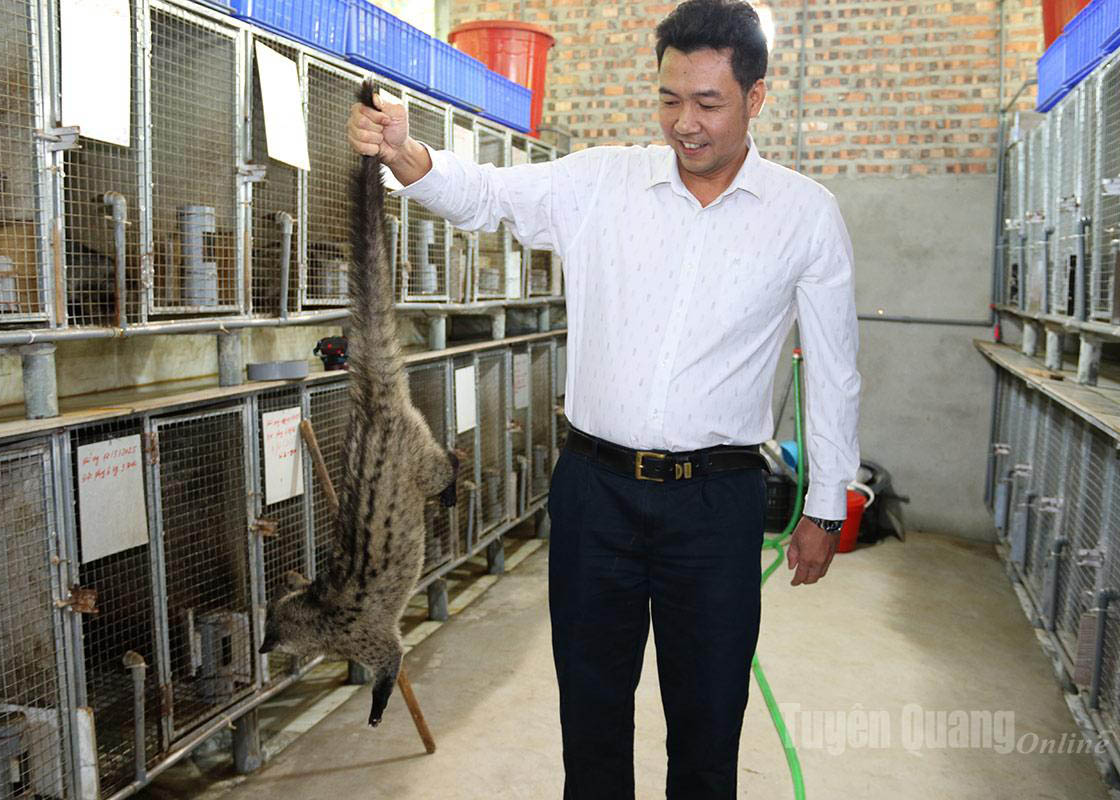 |
| The civet-farming facility of Bui Ngoc Thinh. |
Thinh began his venture in 2022 after visiting a civet farm in Thai Nguyen. Despite limited capital and little experience, he decided to pursue this high-value but challenging species. The early days were difficult: some civets experienced heat shock, others refused food due to environmental changes. Determined to succeed, Thinh sought knowledge from documents and large farms in Thai Nguyen and Bac Giang, carefully adjusting his methods, monitoring temperature and humidity, and documenting every feeding regime.
From just a few breeding pairs, his stock has expanded to more than 200 civets, including breeding, seed, and commercial animals. Thanks to proper care, the breeding rate exceeds 80 percent with high survival rates. Three-month-old seed civets sell for around VND 4.5 million each, while commercial civets fetch VND 1.5–1.8 million per kilogram, helping Thinh earn around VND 500 million in profit each year.
Because civets are a protected species, Thinh fully registered his farm with the forest protection authorities and complies with all regulations on origin and captive-breeding conditions. His credibility has attracted buyers from Hanoi, Hai Phong, Ninh Binh, Lao Cai, and Phu Tho. He also supplies commercial civets to specialty restaurants and works with businesses researching musk extraction - an ingredient of interest in cosmetics and pharmaceuticals.
Thinh’s farm is built methodically, with brick-and-steel enclosures, heat-resistant roofing, separate sleeping and activity areas, and an independent waste-treatment system. Cameras are installed to monitor behavior, especially during the sensitive breeding period. Strict hygiene and disease-prevention measures have kept the farm free of major outbreaks for years.
Beyond running his own operation, Thinh shares techniques with local people, from selecting breeds and building enclosures to health monitoring and market connections. Several households in the commune have begun civet farming following his guidance, achieving promising income. Looking ahead, Thinh plans to expand through cooperative linkages that provide both breeding stock and product-consumption support, to register an OCOP product to further enhance brand value and reach larger markets.
Hoang Kim Ngoc


READER COMMENTS