
Preserving traditional costumes
Alongside language and customs, traditional costumes are a defining element of each ethnic community’s cultural identity. Amid the pace of modern life, as ready-made clothing becomes increasingly common, many women in remote mountainous villages continue to sit by embroidery frames and looms, preserving each stitch and pattern as a way of safeguarding their cultural heritage while creating sustainable livelihoods.
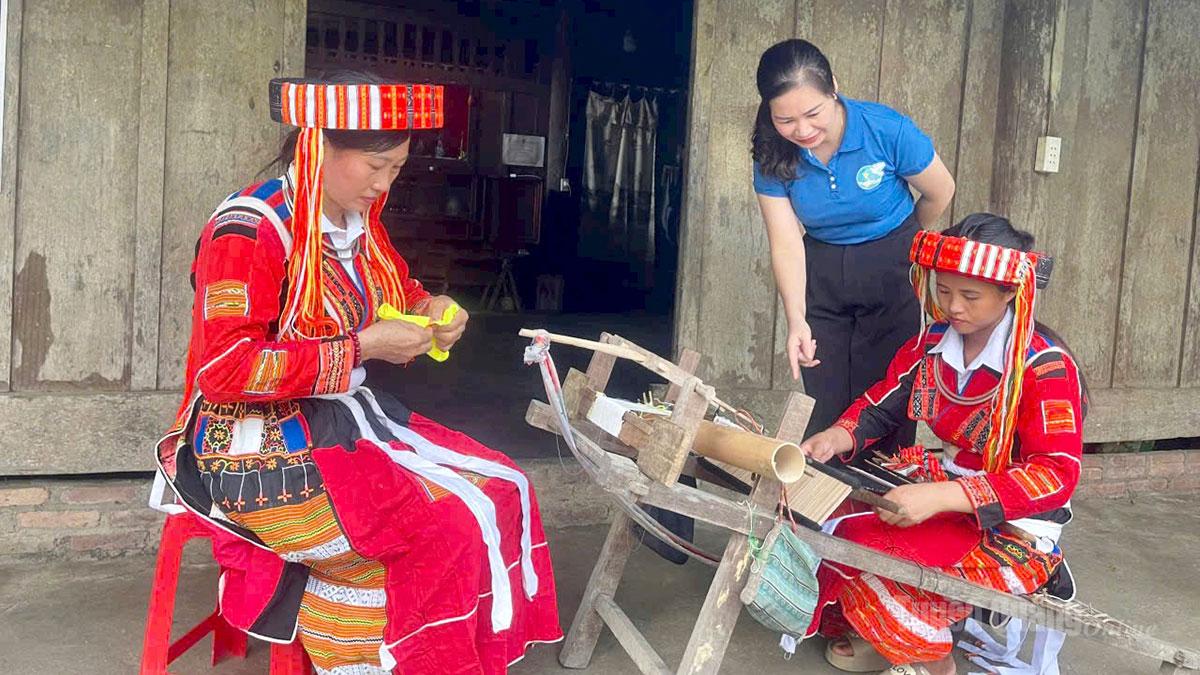 |
| Women’s Union members in Minh Quang Commune preserve traditional brocade embroidery and weaving. |
In Minh Quang Commune, home to more than 700 members of the Pa Then ethnic group, traditional costume embroidery has been maintained across generations. From a young age, Pa Then girls are introduced to embroidery frames and taught to craft intricate patterns rich in cultural symbolism. These garments are more than clothing; they are cultural assets prepared by young women before marriage.
The commune currently has three women’s association branches that maintain embroidery and brocade weaving classes, attracting nearly 100 members. Beyond traditional costumes, participants produce a variety of items such as blankets, pillowcases, scarves, bags and purses to serve tourism demand and supplement household incomes.
Moving beyond household-based production, several localities have elevated preservation efforts through cooperative models. A notable example is the Can Ty Linen Weaving Cooperative in Can Ty Commune, where Mong ethnic women continue to carry out every stage of the traditional linen-making process by hand, from planting flax and extracting fibers to dyeing and pattern drawing. The cooperative provides stable employment for six regular workers with an average monthly income of around VND 5 million. It has developed more than 35 product lines, including seven items certified under the national OCOP program with three- and four-star ratings.
In addition to community initiatives, vocational training has been supported through government programs. Under Project 6 of the National Target Program on Socio-Economic Development in Ethnic Minority and Mountainous Areas for 2021–2025, multiple training courses on traditional embroidery and textile techniques have been organized for smaller ethnic groups such as Pa Then, La Chi, Lo Lo and Bo Y.
However, the convenience of modern clothing and ongoing economic pressures pose significant challenges to preservation efforts. Ensuring that traditional costumes remain part of daily life requires coordinated support from authorities and organizations so that each stitch not only preserves cultural identity but also opens long-term development opportunities for highland women and future generations.
Nhu Quynh


READER COMMENTS