
Lo Lo bronze drums: The sacred echo of Vietnam’s Northern frontier
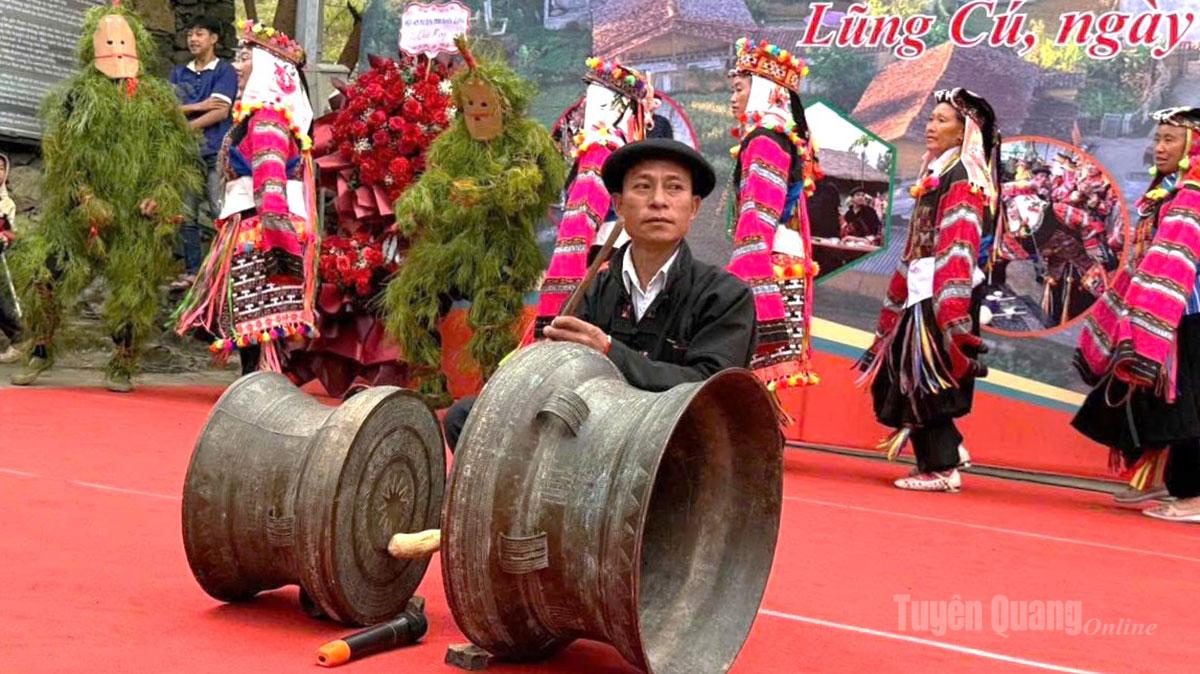
Along Vietnam’s northernmost frontier, the resonant sound of the Lo Lo bronze drum continues to echo as a sacred thread connecting heaven and earth, humanity and the spiritual realm. For the Lo Lo people, the bronze drum is not merely a ritual instrument but the very soul of their culture - a treasured heritage honored as a National Treasure.
 |
The Lo Lo are one of Vietnam’s 16 ethnic groups with very small populations. In Tuyen Quang Province, they reside mainly in Lung Cu, Dong Van, Meo Vac, Sa Phin and Son Vi communes, with a total of 444 households and 1,909 people. Though accounting for only around 0.1 percent of the province’s population, the Lo Lo community has maintained a strong sense of cohesion, preserving its distinctive cultural values almost intact across generations. At the heart of this cultural legacy stands the bronze drum - both sacred symbol and spiritual core of the Lo Lo people.
According to cultural researchers, the bronze drum embodies the harmony of yin and yang, heaven and earth, humans and deities. Each motif and engraved detail on the drum’s surface closely mirrors patterns found on traditional costumes, reflecting a unified aesthetic and worldview. The drum face is intricately decorated with comb-like motifs, concentric circles with central dots, stylized masked human figures interwoven with symbolic bands. At the center radiates a sun motif, a symbol of light and life, surrounded by circular patterns reminiscent of planets orbiting the cosmic axis.
What sets the Lo Lo bronze drum apart from the renowned Dong Son drums and other bronze drum traditions is the presence of circular perforated motifs arranged on the drum face - a feature unique to the Lo Lo. Each pattern tells a story, a page of history cast in metal. The drum thus functions not only as a musical instrument but as a “spiritual map,” where humans and the universe converge in profound aesthetic and spiritual depth.
Elder Vang Sanh Hoanh, 94, of Lo Lo Chai village in Lung Cu commune, explains that Lo Lo bronze drums always exist in pairs, a male drum and a female drum. The male drum is smaller than the female, symbolizing the harmony of yin and yang and the generative power of fertility beliefs deeply rooted in the community’s spiritual life.
Carrying artistic, spiritual and philosophical values, the Lo Lo bronze drum is not only a cultural treasure but also a historical testament to the rich identity of the Lo Lo people at Vietnam’s northernmost point. Its significance extends beyond the community itself to become a shared heritage of the nation. In 2015, a pair of 5th-century Lo Lo bronze drums currently preserved at the Tuyen Quang Provincial Museum was officially recognized as a National Treasure by the Prime Minister.
Amid modern life, the deep, solemn beat of the Lo Lo drum still resonates in major rituals such as heaven worship ceremonies, rain-praying rites, earth deity worship and ancestral ceremonies - the latter recognized as part of Vietnam’s National Intangible Cultural Heritage. Each drumbeat carries a sacred message, reminding younger generations of their ancestral roots while nurturing pride, solidarity and a shared responsibility to safeguard cultural heritage.
Since 2015, the Lo Lo Ethnic Cultural Festival has been held annually in various localities to preserve and promote traditional values. The festival is not only a space where the sacred drum echoes with ethnic pride but also a bridge transforming heritage into economic assets. Authorities have actively collected artifacts, restored Lo Lo cultural spaces, encouraged the preservation and restoration of ancient drums, and supported the transmission of drumming techniques and ritual meanings to younger generations.
In Lo Lo Chai village, recognized as one of the “Best Tourism Villages in the World”, elderly artisans continue to pass down drumming skills, sustaining the rhythm between tradition and modernity. Vang Di Dai, a young man born in the 1990s and once a gifted apprentice of the village elders, has now become a successor, helping revive traditional bronze drum rituals. “Drumming is not for performance,” he says. “It is to remind us that we are Lo Lo people, still hearing the call of our ancestors in every beat.”
Meanwhile, Vuong Duc Thang, inspired by pride in his community’s sacred treasure, has developed Danh House homestay. “Danh,” meaning bronze drum in the Lo Lo language, is a simple name that encapsulates the cultural essence of the people. The homestay features five pairs of bungalows symbolizing the five longstanding Lo Lo clans in the northernmost region, designed to faithfully replicate the male and female bronze drums, complete with meticulously carved traditional motifs.
Since opening in April 2024, Danh House has welcomed more than 10,000 visitors, generating nearly VND 4 billion in revenue and creating stable jobs for five young Lo Lo workers. The model stands as a vivid testament to Tuyen Quang’s new tourism direction - sustainable development rooted in ethnic cultural identity. As visitor Bui Thuy Mao from Phu Tho Province shared, “Danh House is not just a stop on the journey to Vietnam’s far north. It is a living cultural home where Lo Lo culture is not confined to a museum, but lives within daily life.”
From sacred drumbeats echoing in rituals to the drum’s iconic form shaping community-based tourism spaces, Lo Lo culture is experiencing a powerful revival grounded in its unique identity. Each drumbeat is a pulse of life, awakening ethnic pride and opening a sustainable path forward for the Lo Lo community at the northern frontier of the nation.
Thu Phuong


READER COMMENTS